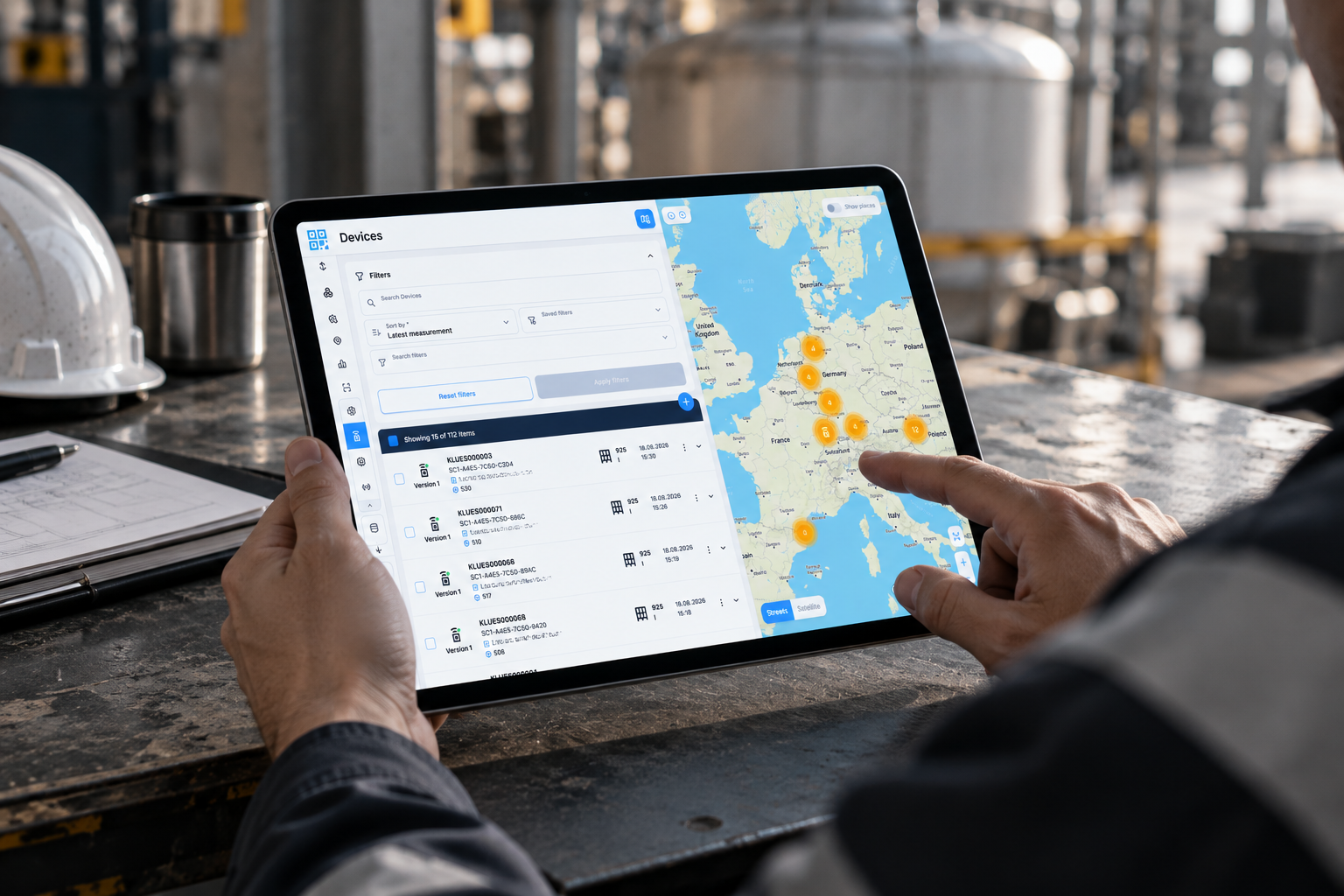
Anyone looking to digitize tanks, IBCs, and other industrial packaging should consider more than just the sensors used when selecting an IoT solution. While reliably tracking fill level, temperature, location, or movement provides the necessary foundation, the real added value comes from processing and utilizing this data.
Powerful software determines whether measurement values are merely displayed on a dashboard or are directly integrated into existing processes, trigger automated actions, and serve as the basis for informed decisions. This is exactly where Packwise Flow 2.0 comes in. The platform centrally aggregates data from the Packwise Smart Cap, organizes it clearly, and enables its integration into existing business systems. This creates a connection between physical assets, real-time data, and operational processes.
Key Features at a Glance
- Centralized platform: All relevant sensor data consolidated in Packwise Flow 2.0.
- Real-time transparency: Keep track of fill level, temperature, location, and movement at all times.
- Seamless integration: APIs and webhooks connect Packwise Flow to existing systems.
- Smart automation: Alerts and rules reduce manual processes.
- Easy collaboration: Relevant data can be shared selectively with partners.
- Reliable Data Source: The Smart Cap delivers precise data directly from the asset.
- AI-ready: Structured data enables forecasting, anomaly detection, and other AI applications.
Why does the software determine the added value of an IoT solution?
An industrial IoT solution essentially consists of two layers: the sensors on the physical asset and the software where the collected information is aggregated and processed. The Packwise Smart Cap measures fill level, temperature, location, and movement. These measurements provide transparency, but they only realize their full potential when they are centrally available and integrated with a company’s business processes.
Packwise Flow 2.0 handles this task. The software consolidates the sensor data in a central environment, visualizes current statuses and trends, and makes the information available for further applications and systems. As a result, companies not only gain an overview of current fill levels but can also use this information immediately for inventory planning, reordering, or other operational processes.
As a result, digital tank monitoring evolves from a purely monitoring solution into a tool for actively controlling processes. What matters most is no longer just what data is collected, but how efficiently that data can be translated into concrete decisions and actions.
Why a Dashboard Alone Is Not Enough
A central dashboard initially creates transparency and enables companies to view the status of their tanks and containers regardless of location. However, the benefits of an IoT solution remain limited if employees then have to manually transfer the displayed information into ERP systems, planning tools, or other applications.
Modern industrial IoT software should therefore not function as an additional siloed system, but rather integrate as seamlessly as possible into a company’s existing IT landscape. Packwise Flow 2.0 follows this approach by making sensor data available not only within the platform but also to existing systems and processes.
This way, companies do not have to completely replace their established processes to leverage IoT data. Instead, the additional real-time information can complement existing applications and be utilized where it is needed for operational decisions.
API-First: Integrating Sensor Data into Existing Systems
A platform’s integration capabilities are among the most important criteria when selecting an Industrial IoT solution. Companies already work with ERP, BI, and other business systems in which core processes are managed and information is processed. An IoT platform should therefore complement this existing infrastructure rather than creating yet another isolated data source.
To achieve this, Packwise Flow relies on an API-first architecture. Data can be exchanged between the platform and existing systems via REST APIs and webhooks. This allows information from the Packwise Smart Cap to be integrated into existing digital processes and automatically processed there.
Furthermore, the integration with Power BIenables customized analyses and reports. For example, companies can evaluate the collected data across multiple locations and combine it with other corporate data. Individual sensor measurements thus form a database that can be used beyond traditional tank monitoring.
From Real-Time Data to Automated Processes
The added value of real-time data lies not only in the ability to view current conditions at any time. This information becomes particularly relevant when changes can be responded to automatically. This is precisely why automation and rule-based processes play a central role within a modern IoT platform.
With Packwise Flow, you can define rules and alerts for various application scenarios. For example, if a fill level reaches a specified threshold or an unusual temperature change occurs, the relevant information can be automatically provided. Based on this, processes such as reorders, pickups, or warning notifications can be managed more effectively.
As a result, companies no longer need to continuously monitor every single tank manually. Instead, relevant changes become automatically visible as soon as action is required. Digital tank monitoring thus supports not only monitoring but also, increasingly, the active control of operational processes.
A Centralized Platform Instead of Dispersed Individual Solutions
In many companies, IoT landscapes develop over an extended period of time. One solution tracks fill levels, another provides location information, and other applications are used for reporting, inventory planning, or other tasks. As a result, relevant data is scattered across different systems, making it difficult to share and creating additional integration and administrative overhead.
Packwise therefore takes a holistic approach. The Packwise Smart Cap captures relevant information directly at the asset, while Packwise Flow 2.0 consolidates this data into a central platform and makes it available for further processes. This provides companies with a unified database for fill levels, temperature, location, and movement, rather than having to work with multiple separate sources of information.
This approach becomes particularly important for larger installations. The more tanks, locations, users, and processes are digitized, the more critical it becomes to have a software architecture that can centrally manage growing volumes of data and make it available for various use cases.
Simplifying Collaboration Along the Supply Chain
Industrial supply chains often involve multiple companies and stakeholders. Manufacturers, suppliers, logistics service providers, and customers rely on information that has traditionally been exchanged via email, phone calls, or other manual coordination processes. This results in additional effort and information gaps.
Packwise Flow 2.0 enables the targeted sharing of selected data with external partners. The “Invite and Share” feature allows relevant information to be made available to customers and other stakeholders, enabling multiple parties to work with the same up-to-date data set.
As a result, sensor data is not only usable within a company but can also support collaboration throughout the supply chain. When relevant information is available where it’s needed, coordination processes can be reduced and workflows made more transparent.
Reliable Sensor Technology as the Foundation of High-Performance Software
Even high-performance software relies on reliable input data. The quality of the sensor technology therefore remains an essential component of a holistic IoT solution. Inaccurate or incomplete measurements cannot be fully compensated for by a dashboard or by downstream analyses.
The Packwise Smart Cap measures fill level, temperature, location, and movement directly at the asset. For fill-level measurement, Packwise relies on radar technology, which enables reliable readings even under demanding industrial conditions. Especially when dealing with foam, deposits, or chemical liquids that are difficult to measure, robust measurement technology forms a crucial foundation for further data processing.
That’s why Packwise’s sensor technology and software are directly integrated. While the Packwise Smart Cap generates the necessary real-time data, Packwise Flow 2.0 consolidates this information and makes it usable for operational processes. Only the interaction of both components creates a seamless connection between the physical asset and digital business processes.
How does Packwise Flow lay the foundation for AI applications?
As the volume of available sensor data increases, new application possibilities emerge that go beyond traditional monitoring and rule-based alerts. AI-powered analytics can identify patterns in historical and current data and help companies better assess future developments.
In demand forecasting, for example, historical fill-level data is used to predict future material requirements. Anomaly detection can identify unusual changes in fill level, temperature, or movement, while predictive maintenance uses patterns in sensor data to identify potential maintenance needs early on.
A continuous and structured database is a prerequisite for such applications. Packwise Flow 2.0 provides the infrastructure to centrally aggregate sensor data and make it available for further analysis. Thus, the platform not only forms the foundation for current monitoring and automation processes but also for future data-driven applications.
What should modern Industrial IoT software be capable of?
When selecting an IoT solution, companies should therefore not focus exclusively on which parameters a sensor can measure. At least as important is the question of how the collected data can subsequently be processed and integrated into existing processes.
A high-performance Industrial IoT platform should centrally consolidate data from various assets, make information available in real time, and enable customized analyses. At the same time, it should feature open interfaces so that sensor data can be integrated into ERP, BI, and other business systems. Features for alerting, automation, and data sharing also make it possible to derive concrete actions from the information gathered.
The more closely digital processes and AI applications are intertwined in the future, the more important a scalable data architecture will become. The software should therefore not only meet today’s monitoring requirements but also lay the foundation for future data-driven processes.
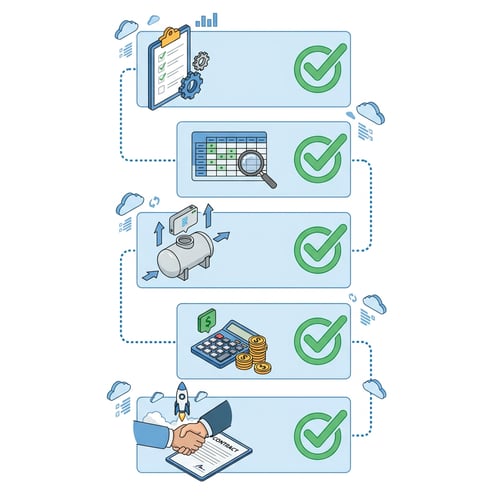
Step by Step: How to Evaluate an Industrial IoT Platform
Step 1: Define business processes and requirements
Before companies compare individual hardware features, they should first determine which processes are to be improved with the IoT solution. These may include, for example, inventory planning, reordering, cross-site transparency, or collaboration with customers and suppliers. Based on these specific requirements, companies can then determine which data, integrations, and software functions are actually needed.
Step 2: Check Integration Capabilities
An IoT platform should expand the existing IT landscape and not create an additional data silo. Therefore, it is advisable to check during the selection process which APIs, webhooks, and integration options are available and how the collected data can be integrated into existing ERP, BI, and business systems.
Step 3: Consider automation options
In addition to displaying information, you should assess which processes can be automated based on sensor data. The less manual control and data transfer required, the more effectively an IoT platform can support existing workflows and reduce operational overhead.
Step 4: Ensure scalability
A platform should be capable of supporting both small pilot projects and larger installations with numerous assets, locations, and users. Companies should therefore consider early on how easily additional sensors and tank types can be integrated and whether all relevant information can continue to be managed centrally.
Step 5: Assess Future-Proofing
Industrial IoT platforms are increasingly evolving from pure monitoring systems into data-driven decision-making platforms. A reliable data foundation, open interfaces, and a scalable software architecture are therefore essential prerequisites for integrating automated and AI-powered applications in the future.
Conclusion: The software determines what becomes of your data
The digitization of tanks and industrial packaging begins with reliable sensor technology, but it doesn’t end there. The decisive added value is only realized when the information gathered can be centrally consolidated, analyzed, and integrated into operational processes.
Packwise Flow 2.0 is therefore the heart of the Packwise solution. Together with the Packwise Smart Cap, it creates a seamless connection between physical assets and digital business processes. Real-time data on fill level, temperature, location, and movement is not only made visible but can also be used for analysis, integrations, automated workflows, and collaboration throughout the supply chain.
In this way, Packwise goes beyond traditional level measurement or simple tracking. The Smart Cap creates the data foundation, while Packwise Flow 2.0 ensures that this data is transformed into actionable insights for better and more efficient processes.
FAQs: Packwise Flow 2.0 and Industrial IoT Software
What distinguishes an IoT platform from traditional level monitoring?
Traditional level monitoring focuses primarily on recording and displaying measured values. An IoT platform, on the other hand, centrally aggregates various sensor data and enables it to be analyzed, integrated with existing systems, and utilized for further processes. This allows individual measurement values to be transformed into alerts, analyses, and automated workflows, for example.
What data does Packwise Flow process?
Packwise Flow processes the information collected by the Packwise Smart Cap regarding fill level, temperature, location, and movement. This data is made available centrally and can be used for various applications and processes.
Can Packwise Flow be integrated into existing systems?
Packwise Flow is based on an API-first architecture. Data can be exchanged with existing systems via REST APIs and webhooks and further processed within existing workflows.
Can data be shared with customers and partners?
Using the “Invite and Share” feature, selected information can be made available to customers and other partners. This enables various stakeholders along the supply chain to collaborate based on the same up-to-date data.
Why is sensor data important for AI applications?
Applications such as demand forecasting, anomaly detection, and predictive maintenance require a continuous and reliable data source. The sensor technology provides information from the physical supply chain, while the software centrally consolidates this data and makes it available for further analysis.
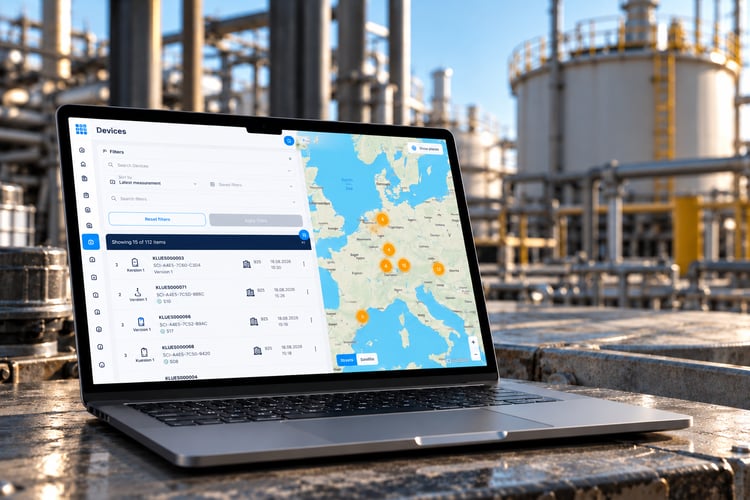
Get more out of your tank data!
The Packwise Smart Cap provides you with reliable data directly from the asset. Packwise Flow 2.0 makes this data usable for your processes, creates transparency and automation, and thereby visibly reduces costs!
Learn from our experts now how Packwise Flow 2.0 connects your tank data with your business processes.