Level measurement sounds like a straightforward task. But anyone who works with tanks, IBCs, or containers on a daily basis knows: the reality of industrial operations is anything but simple. Steam, foam, aggressive media, fluctuating temperatures – all of these put measurement technology to the test. Choosing the right technology determines whether an operation runs reliably or gets held back by inaccurate readings.
The Packwise Smart Cap relies on radar technology – and for good reason.
Radar: The Robust Choice for Demanding Conditions
Radar-based level measurement is non-contact and insensitive to colour, pressure, temperature, and vapour. While ultrasonic sensors quickly reach their limits when faced with foam, condensation, or temperature fluctuations, radar delivers stable, reliable readings even under difficult process conditions.
That's not a theoretical advantage – it makes a real difference in day-to-day operations:
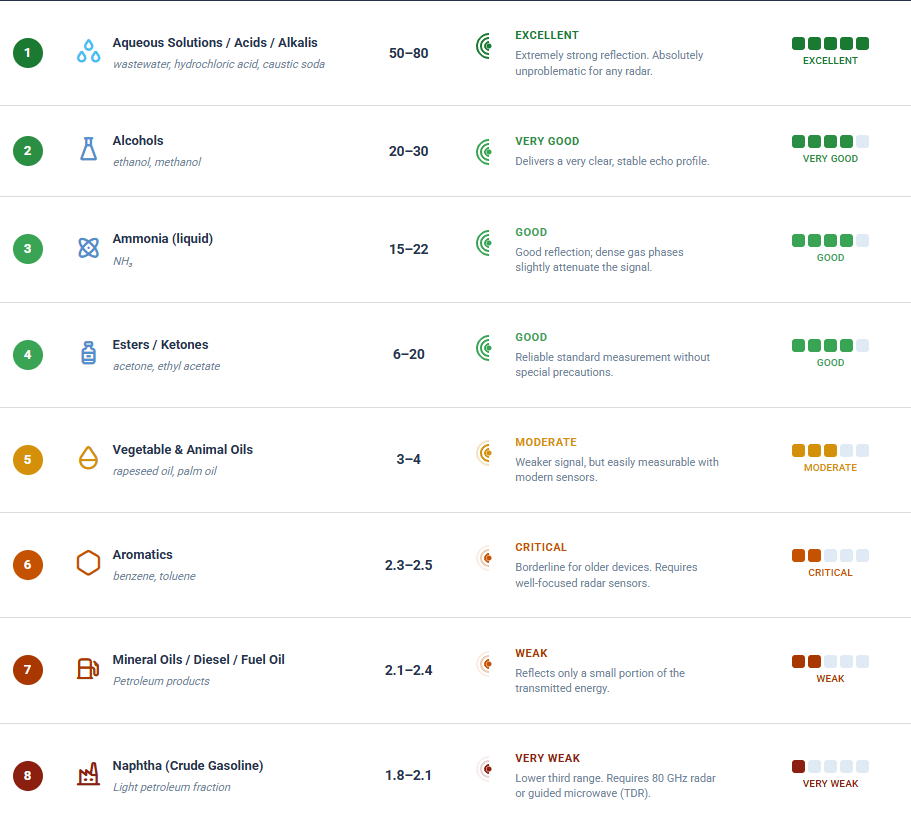
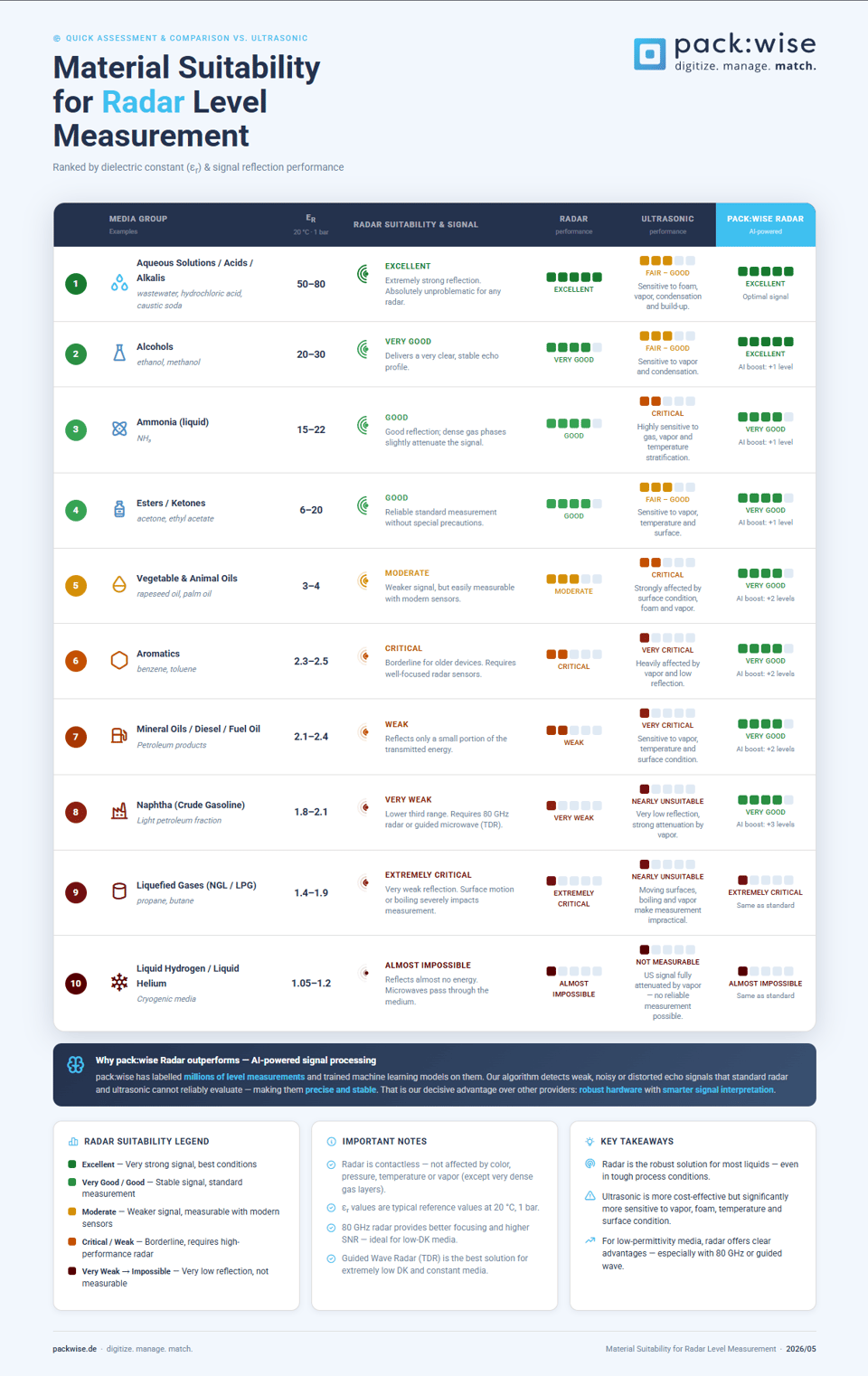
- Aqueous solutions, acids, and alkalis (e.g. wastewater, hydrochloric acid, caustic soda) with a dielectric constant of 50–80 are captured by radar with excellent results – extremely strong reflection, absolutely unproblematic for any radar device.
- Alcohols such as ethanol or methanol also deliver a clear, stable echo profile – very good measurement results, even where ultrasound reaches its limits due to vapour and condensation.
- Esters and ketones (acetone, ethyl acetate) are measured reliably without any special precautions.
- Vegetable and animal oils (rapeseed oil, palm oil) are considered technically challenging to measure. Radar delivers significantly better results than ultrasound, which is strongly affected by foam formation and surface conditions.
- Mineral oils, diesel, and heating oil – with a dielectric constant of just 2.1–2.4, these media reflect only a small fraction of the emitted energy. For ultrasound, this is barely manageable. Radar, especially in the 60/80 GHz range, remains the superior choice here.
- Naphtha (light petroleum) is a challenge even for radar – with εᵣ values of 1.8 to 2.1, it sits at the lower end of what is measurable. 80 GHz radar or guided microwave (TDR) is recommended here.
- Liquefied gases such as propane and butane are extremely critical due to moving surfaces and boiling – both for ultrasound and standard radar.
In short: radar is the more robust, more reliable measurement technology for the vast majority of industrial liquids – especially where ultrasound fails.
AI-Powered Signal Processing: The Decisive Advantage of the Packwise Smart Cap
What sets the Packwise Smart Cap apart from conventional radar sensors is not just the hardware – it's the intelligence behind it.
Packwise has labelled millions of level measurements and trained them using machine learning. The algorithm detects weak, noisy, or disturbed echo signals that standard radar and ultrasound cannot reliably evaluate – and makes them precisely and stably measurable.
The result: the Smart Cap raises measurement quality in many applications by one to three levels compared to conventional solutions:
| Medium |
Standard Radar |
Smart Cap with AI |
| Alcohols, esters, ketones |
Very good |
Excellent (+1 level) |
| Vegetable & animal oils |
Moderate |
Very good (+2 levels) |
| Aromatics (benzene, toluene) |
Critical |
Very good (+2 levels) |
| Mineral oil, diesel, heating oil |
Weak |
Very good (+2 levels) |
| Naphtha |
Very weak |
Very good (+3 levels) |
More robust hardware combined with smarter signal interpretation – that is the strength that sets Packwise apart from other providers.
What This Means for Your Operations
Good measurement technology is not an end in itself. It provides the data foundation for better decisions: in inventory planning, transport management, and supply chain control.
With the Packwise Smart Cap, you benefit concretely from:
- Greater transparency – real-time fill levels without manual checks
- Reduced downtime risk – stable readings even with difficult media and process conditions
- Faster application assessment – identify technical risks earlier, conduct customer conversations with more confidence
- Reduced manual effort – automated data collection instead of regular on-site inspections
- A solid decision-making basis – no assumptions, just reliable measured values
The Smart Cap doesn't just perform in the lab – it's designed for the industrial day-to-day: robust, reliable, and easy to integrate.
Conclusion: The Right Technology for Real-World Conditions
In industrial environments, good measurement technology isn't about perfect lab conditions – it's about working reliably under real-world conditions. Steam, aggressive chemicals, fluctuating temperatures, difficult-to-measure media: the Packwise Smart Cap was developed precisely for these scenarios.
Radar is the robust choice. AI-powered signal processing makes it even better. And the Smart Cap brings both together in a solution that works in daily operations.
Want to know whether the Packwise Smart Cap is the right solution for your application?
Our team will assess your specific media and process conditions together with you – and find the optimal solution for your tank monitoring. Fast, well-founded, and straight to the point.