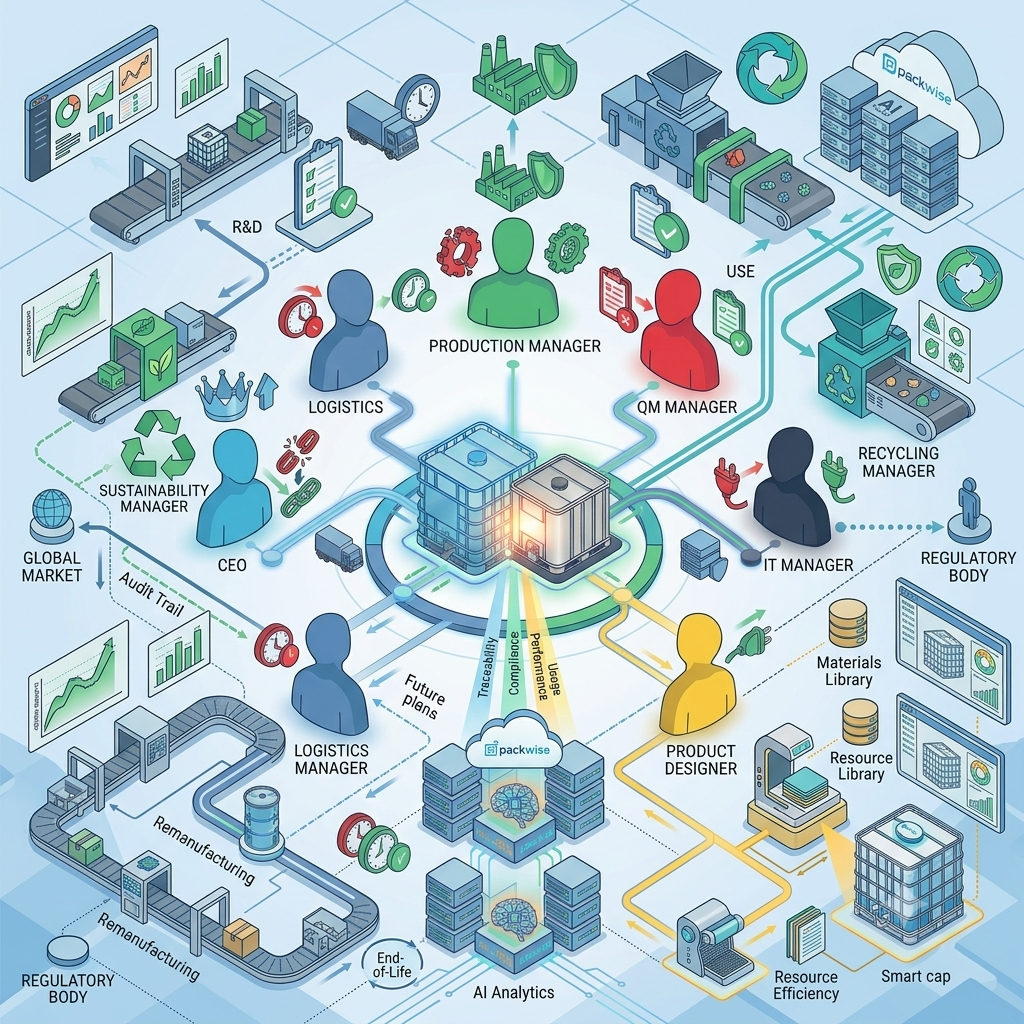
Sustainability reporting, European packaging regulation and the Digital Product Passport are changing the data requirements placed on industrial supply chains. Companies will not only need information about what their products and packaging are made of. They will increasingly need reliable insights into how containers are actually used, moved, emptied and returned.
The Corporate Sustainability Reporting Directive, or CSRD, establishes a European framework for more structured and verifiable corporate sustainability reporting. The Packaging and Packaging Waste Regulation, or PPWR, strengthens requirements related to packaging prevention, reuse, recyclability and resource efficiency. The Digital Product Passport is intended to make relevant product, material and sustainability information digitally accessible, supporting transparency, circularity and compliance.
For manufacturers, fillers, chemical companies, logistics teams and operators of industrial reusable packaging, this creates a fundamental question: Where will the data required for both regulatory compliance and operational improvement come from?
The problem is not a lack of software, but a lack of physical supply chain data
Most industrial companies already use ERP, production, warehouse and transport management systems. These systems record orders, deliveries, inventories and business transactions. What they often lack is continuous visibility into individual containers once those assets leave the company’s own site.
Without an industrial container tracking system, companies may not know the precise location of an IBC, its actual fill level, when its contents will be depleted, how long the container has remained at a customer site, how much residual product it contains or when it can be collected and reused.
These are not only operational questions. They are directly connected to resource efficiency, packaging circulation and the performance of reusable asset loops.
When container-level information is not captured continuously, a gap emerges between the physical supply chain and the company’s digital systems. That gap makes it difficult to optimise returnable asset fleets, reduce product losses and quantify the real impact of circular economy initiatives.
Why CSRD, PPWR and the Digital Product Passport need a shared data core
CSRD, PPWR and the Digital Product Passport serve different regulatory purposes. However, they share a need for structured, traceable and reliable information about materials, packaging, operations and resource use.
Instead of building a separate data process for every requirement, companies can develop a common data core. This connects master data from ERP and product information systems with operational data from the physical supply chain.
A shared data foundation may include:
- Container type and unique asset identity
- Product and material information
- Location and movement data
- Fill levels and consumption patterns
- Temperature and condition data
- Usage and circulation cycles
- Dwell times and return times
- Residual quantities, losses and deviations
The European Commission describes the Digital Product Passport as a digital identity card for products, components and materials. It is intended to store relevant information that supports sustainability, circularity and legal compliance. Exact data requirements will be defined through product-specific rules and related legislation.
Companies therefore do not need to wait until every future data field has been finalised before improving their infrastructure. By making real operational processes measurable today, they can build a foundation that supports multiple regulatory and business applications.
Smart Cap and Packwise Flow: Turning an analogue container into a usable data point
Packwise closes the container-level data gap through the combination of the Packwise Smart Cap and Packwise Flow.
The Smart Cap transforms analogue industrial containers into digitally trackable assets. It captures data such as fill level, temperature, location and movement directly from the container. Packwise Flow brings this information together, makes it available for analysis and enables integration into existing ERP and enterprise systems.
This creates more than another isolated software interface. It connects the physical state of an industrial container with the company’s digital processes.
The greatest value does not come from capturing a single measurement. It comes from continuously analysing the resulting data.
Genuine data mining instead of digitalisation as a buzzword
A single location point can show where a container is. A continuous data history can reveal how an entire container loop performs.
By analysing fill levels, movements, temperatures and time patterns, companies can identify relationships that remain invisible without IoT-based measurements. They can determine which customer sites cause extended dwell times, where returns regularly stall, when inventory is likely to run low and how many containers the business actually needs.
Packwise Flow turns measurements into operational intelligence. It can provide a data basis for:
- Analysing consumption and forecasting demand
- Triggering replenishment or collection processes
- Identifying unusual dwell times and deviations
- Reducing residual quantities and product losses
- Shortening container cycle times
- Rightsizing returnable asset fleets
- Detecting temperature and quality risks
- Evaluating circular flows across company boundaries
In this context, data mining does not mean collecting as much information as possible. It means using precise, continuous measurements to discover relevant patterns and enable better decisions.
Only a few years ago, economically viable sensor data at container level was often unavailable. Industrial IoT technology can now capture information directly from live operations and connect it to existing systems.
Digitalisation therefore becomes more than a label. It produces measurable operational value.
How container tracking can support PPWR implementation
The PPWR is the European regulation on packaging and packaging waste. Regulation (EU) 2025/40 entered into force on 11 February 2025 and generally applies from 12 August 2026. Its objectives include reducing packaging waste and strengthening reuse, recyclability and resource efficiency.
The exact obligations depend on the packaging type, application and company. Container tracking does not replace a legal assessment and does not automatically constitute full PPWR compliance.
However, it can provide operational evidence that helps companies understand and improve reusable packaging systems. Actual cycle times, dwell times, return behaviour and usage patterns show whether a reuse model is functioning in practice and where intervention is required.
A reusable container is not sustainable simply because it can theoretically be used again. Its real impact depends on how many times it is used, how reliably it returns and how efficiently the entire loop is managed.
How precise container data can improve CSRD reporting
The CSRD establishes requirements for structured corporate sustainability reporting. The information relevant to an individual company depends on factors including the applicable scope, its materiality assessment and the reporting standards in force.
Operational container data can provide a stronger foundation for selected metrics, analyses and improvement programmes. It can help companies understand resource consumption, product losses, transport processes and the actual use of reusable industrial packaging.
It is important to distinguish between raw measurement data and a final reporting metric. Packwise provides information from real container processes. Each company must determine how that information is methodologically incorporated into its sustainability reporting and compliance framework.
The benefit of continuous measurement remains significant: decisions and statements can rely less on assumptions, samples or manual feedback and more on traceable operational data.
From retrospective reporting to controllable circular operations
Regulatory reporting often looks backwards. Circular operations must work in real time.
The greatest value of real-time and historical data therefore lies not in documenting completed processes, but in enabling companies to act.
When unusual consumption is detected early, its cause can be investigated. When a fill level falls below a defined threshold, replenishment can be prepared. When an empty container remains at a location for too long, collection can be initiated. When a fleet consistently shows low utilisation, the number of assets can be adjusted.
This creates a closed operational loop:
Measure precisely, analyse intelligently and manage proactively.
This is where regulatory data requirements and business value converge. The same data foundation that strengthens transparency and traceability can also reduce cost, consumption, waste and emissions.
A win-win for all supply chain participants
Data-driven container logistics can create value across the supply chain.
Manufacturers and fillers gain greater visibility into inventory, fill levels and consumption. Customers benefit from improved supply reliability and demand-based deliveries. Logistics and pooling partners can plan returns more efficiently. Reusable containers become available sooner and companies need fewer additional assets to compensate for missing or idle stock.
The environmental impact can also improve. Reducing residual product, avoiding losses, increasing container utilisation and preventing unnecessary transport lowers the resource requirements of the overall system. Existing reusable packaging can complete more cycles instead of being replaced by additional assets.
The commercial and environmental effect does not result from tracking alone. It results from the decisions made with the data.
One shared data core instead of separate compliance projects
Companies should not treat CSRD, PPWR and the Digital Product Passport exclusively as separate documentation exercises. All three developments increase the need for structured, traceable and interoperable information.
A more effective approach is to create a shared data core that combines multiple sources.
ERP and master data provide the commercial context. Product and material data describe the packaging and its contents. Smart Caps deliver precise measurements from the physical supply chain. Packwise Flow analyses the data and makes it usable within operational processes and existing enterprise systems.
A regulatory obligation can therefore become a strategic opportunity. Companies can improve data quality, increase supply chain visibility and create a reliable foundation for efficient circular operations.
Conclusion: Circular economy begins with measurability
CSRD, PPWR and the Digital Product Passport are increasing the pressure on industrial companies to provide structured sustainability and packaging data. At the same time, they create an opportunity to move beyond compliance-focused data collection.
With the Smart Cap and Packwise Flow, industrial containers can become part of the digital data infrastructure. Precise measurements are captured continuously, analysed intelligently and translated into operational decisions.
This enables companies to reduce consumption, prevent losses, improve returns, optimise container fleets and manage circular processes with greater transparency.
Circular economy starts with the ability to measure real processes precisely, analyse them intelligently and manage them accordingly. This is where digitalisation stops being a buzzword and becomes measurable value.
Frequently Asked Questions
What does CSRD mean?
CSRD stands for Corporate Sustainability Reporting Directive. It creates an EU framework for more extensive, structured and verifiable corporate sustainability reporting.
What does PPWR mean?
PPWR stands for Packaging and Packaging Waste Regulation. It is the EU regulation addressing packaging and packaging waste, including waste prevention, reuse, recyclability and resource efficiency.
What is a Digital Product Passport?
A Digital Product Passport is a digital identity for a product, component or material. It is intended to make relevant sustainability, circularity and compliance information digitally accessible.
Can container tracking support PPWR compliance?
Container tracking can provide operational data about the use, return, dwell time and circulation of reusable packaging. This information can support the management and evaluation of reuse systems, although individual legal requirements still need to be assessed separately.
What data does the Packwise Smart Cap capture?
The Smart Cap captures parameters including fill level, temperature, location and movement directly from the container. Data is made available through Packwise Flow and can be integrated into existing systems.
What is the difference between container tracking and data mining?
Container tracking captures the condition and movement of individual assets. Data mining analyses the resulting histories to identify patterns, deviations and opportunities for operational improvement.