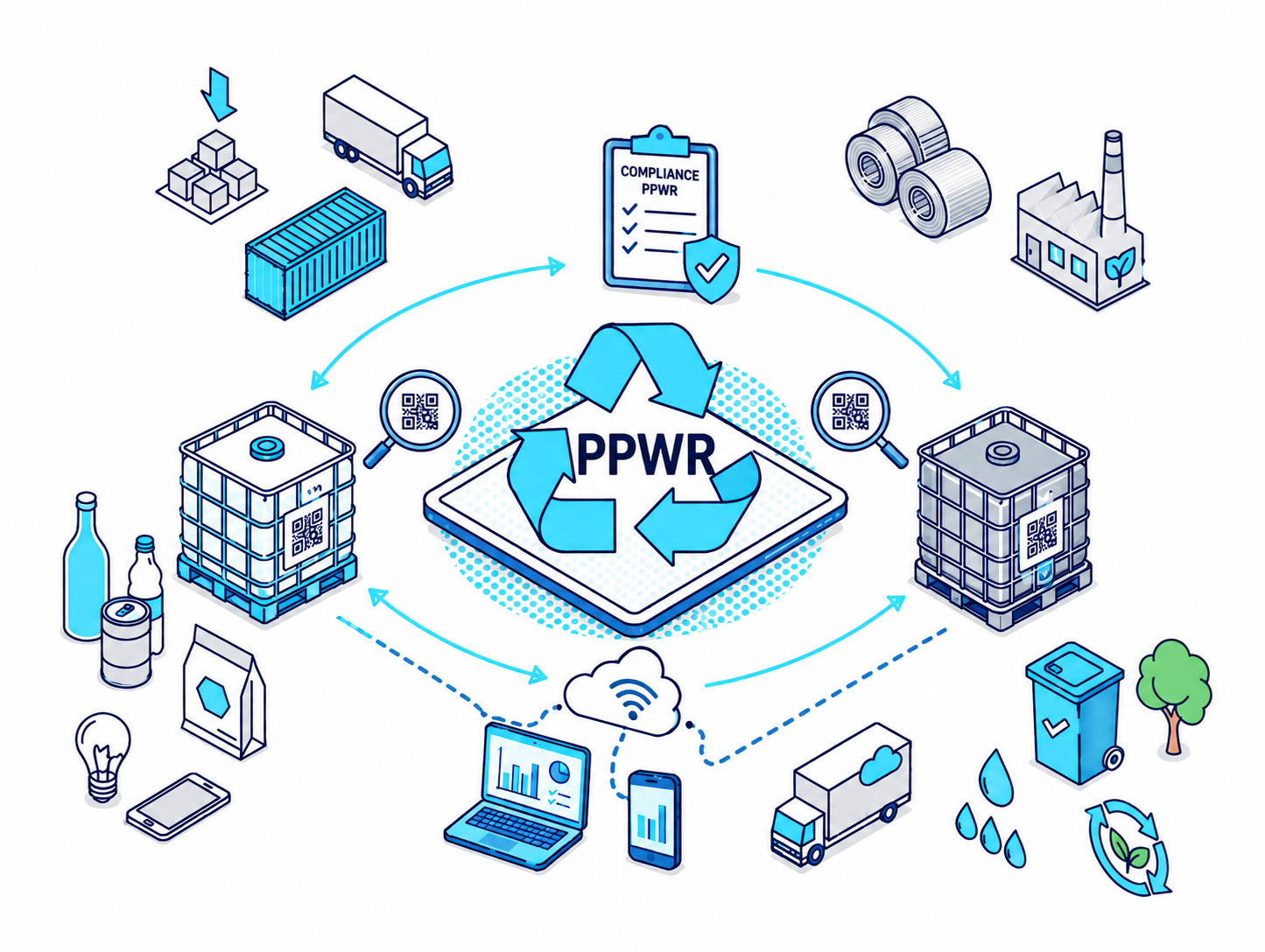
From August 2026, the PPWR (EU 2025/40) applies — and with it, new obligations for anyone operating industrial transport packaging. Companies using IBCs, drums or canisters in chemicals, pharma or logistics will need seamless IBC tracking, a verifiably functioning reusable container management system, and 10-year documentation of every packaging movement. Here is what is changing, which deadlines actually matter — and what supply chain resilience looks like in practice.
What is the PPWR — and why does it directly affect IBCs, drums and canisters?
The Packaging and Packaging Waste Regulation (EU 2025/40), known as the PPWR, has been in force since February 2025 and fully replaces the previous Directive 94/62/EC. As an EU regulation — not a directive — it applies directly and uniformly across all member states, with no scope for national interpretation. Its scope (Art. 2) covers all packaging types regardless of material, explicitly including intermediate bulk containers (IBCs), drums, pails, canisters, pallets and collapsible boxes.
For supply chain managers, logistics and quality professionals in the chemical industry, pharmaceuticals and pooling, this means the previous approach — use robust reusable containers, track internally, move on — is no longer sufficient. The PPWR requires demonstrably functioning closed-loop systems, digital traceability and annual reporting obligations. Companies that have not established this by August 2026 will be operating without a legally secure basis.
Four principles structure the new regulation:
- Reusability: Transport packaging must operate within demonstrably functioning closed-loop systems — the foundation of any modern reusable container management system.
- Recyclability: All packaging receives a grade (A, B, C) — from 2035, grade C will no longer be permitted. Container lifecycle management becomes mandatory.
- Digital traceability: Movements, rotations and conditions must be documented and retrievable on request by authorities — supply chain transparency is no longer optional.
- Packaging waste reduction: Minimum packaging and void space limits become a legal requirement — a direct lever for IBC fleet optimization.
Five phases: The deadlines that actually matter for chemicals and logistics
The PPWR is being introduced in stages. For companies operating IBCs, drums and canisters, five phases are relevant — each with distinct action requirements for operations, IT and management:
| Deadline |
Requirement |
Impact for companies |
⚠ August 12, 2026
Phase 1 – Foundations |
Reuse system must be operationally ready (collection, reconditioning, redistribution).
Traceability obligation begins (Art. 22): suppliers and recipients of all packaging must be identifiable on request.
10-year documentation obligation for reusable packaging starts.
Verification duty: Are suppliers registered in the national producer register? (Art. 44) |
IBC tracking and a digital long-term archive must be in place now. Companies still relying on manual processes will be unable to provide compliant documentation from August onwards. |
February 12, 2027
Phase 2 – Delegated Acts |
Minimum rotation numbers for IBCs, drums, pails and canisters come into force (Art. 11).
Prohibited single-use formats specified (Annex V).
Calculation methods for void space and reuse quotas defined. |
Rotation counts per unit must be systematically recorded and benchmarked against minimum thresholds — the foundation of IBC fleet optimization and pooler reporting. |
February 12, 2029
Phase 3 – Digitalization |
Mandatory "reusable" label + QR code / digital data carrier on every reusable packaging unit (Art. 12).
Required content: rotation count, trip history, reuse system information, collection point details. |
QR infrastructure must use open standards — no vendor lock-in (Art. 44). The digital IBC consignment record becomes a legal requirement. |
January 1, 2030
Phase 4 – Binding Quotas |
40% reuse quota for all transport packaging — IBCs, drums, pallets, canisters (Art. 29).
100% reusable obligation for internal transfers between own sites.
Maximum 50% void space when filling (Art. 24).
Annual electronic reporting on quotas and rotation figures (Art. 29–31). |
Automated reporting becomes mandatory. Manual processes will not scale for authority submissions. Accelerating container turnaround and reducing idle rates become hard compliance KPIs. |
January 1, 2040
Phase 5 – Tightening |
70% reuse quota for transport packaging (Art. 29).
65% recycled content for certain plastic packaging (Art. 7).
Recyclability: only grades A and B permitted (Art. 6). |
Reducing IBC total cost of ownership and extending IBC service life become strategic imperatives. Companies that do not build tracking in 2026 will not reach the 2040 targets. |
What a PPWR-compliant reuse system actually means — and why a robust container is not enough
This is the most common misconception: a durable IBC alone does not qualify as "reusable packaging" under the PPWR. The regulation (Art. 11 + Annex VI) requires a demonstrably functioning system environment — a complete reusable container management system. Only when all seven elements are simultaneously present and documented does the packaging qualify as legally compliant:
| Element |
What it means in practice |
Why it must be documented |
| Governance structure |
Clear rules and responsibilities for all system participants |
Binding accountability across the system |
| Collection |
Systematic return via pool operators, own logistics or collection points — empty container management as an operational process |
Prevents IBC loss and shrinkage, enables the next cycle |
| Reconditioning |
Cleaning, inspection and repair across 6 defined steps per Annex VI — the basis of chemical transport quality assurance |
Packaging must be provably in fit-for-use condition — especially critical for food and pharma |
| Redistribution |
Reconditioned packaging is returned to active use |
The loop must demonstrably close — the core of circular economy IBC optimization |
| Traceability |
Each unit is uniquely identifiable; rotations and trips are recorded — digital batch traceability available on authority request |
Proof for authorities and quota compliance |
| Hygiene & safety standards |
Compliance with all applicable requirements — food law, ADR, GMP |
No health or environmental risks in the loop — particularly relevant for class 3 hazardous goods |
| Reporting |
Access to data on rotations, collection rates and material volumes for all participants — KPI dashboard for container management |
Transparency for authorities, customers and pool partners — the foundation of supply chain visibility |
Bottom line: If you cannot demonstrate that your closed-loop system fulfills all seven elements, you cannot legally declare your packaging as "reusable" to authorities or customers — regardless of how physically robust the IBC is. This applies equally to stainless steel IBCs, plastic IBCs and ISO tank containers.
Reconditioning under Annex VI: The six steps that must be fully documented
For chemical and pharmaceutical companies, reconditioning is the most sensitive point from a regulatory standpoint — and the area where manual documentation most frequently breaks down. The PPWR defines six mandatory reconditioning steps under Annex VI. Companies that want to prevent production downtime and eliminate product spoilage in the supply chain need these six steps as a digital process — not a paper file:
| # |
Step |
What happens |
Tracking relevance |
| 1 |
Condition assessment |
Inspection on return — is the IBC fit for reuse? |
Sensor data and visual inspection logged in the system — basis for container integrity monitoring |
| 2 |
Removal of defective parts |
Damaged components are sorted out — directly reduces container scrap rates |
Recorded in the immutable audit trail |
| 3 |
Transfer to recycling |
End-of-life pathway for components beyond repair |
End-of-life tracking within container lifecycle management |
| 4 |
Cleaning / washing |
Hygienic cleaning according to product requirements — IBC cleaning interval optimization |
Temperature and process logs — seamless cold chain documentation — essential for food and pharma |
| 5 |
Repair |
Restoring full functionality — demonstrably extends IBC service life |
All interventions documented in the audit trail |
| 6 |
Inspection & release |
Final check confirming suitability for reuse |
Release status stored in the IBC tracking system — mandatory for GMP compliance in pharma |
Industry-specific obligations: How chemicals & pharma differ from logistics & poolers
The PPWR applies to everyone — but the specific pain points vary by industry. Here is a direct comparison of the most important implications:
| Chemicals & Pharma (IBCs, Drums) |
Logistics & Poolers |
| IBCs and drums fall directly under the 40%/70% quota (Art. 29) — check ADR exemptions for class 3 hazardous goods |
Proof of minimum rotation numbers per container from Feb. 2027 — basis for an asset utilization dashboard for IBCs |
| Reconditioning records per Annex VI: 6 steps, fully digital — quality assurance for chemical transport |
Void space quota (max. 50%) must be documented for every fill — reducing idle container rates |
| GMP-compliant, end-to-end traceability — lost batch traceability must be fully ruled out |
Supply chain documentation (Art. 22): suppliers and recipients identifiable on request — supply chain visibility platform |
| Real-time monitoring of sensitive liquids and temperature tracking during transport for products with stability requirements |
Multi-stakeholder reporting for pooling systems — returnable transport item tracking |
| 10-year documentation particularly critical (Art. 22) — immutable audit trails as GMP evidence |
Accelerate container turnaround through shorter dwell times and GPS-based location tracking |
| From 2030: contact-sensitive packaging requires 10% recycled content (Art. 7) — sustainable chemical logistics solutions needed |
Annual electronic reporting from 2030 — logistics dashboard for decision-makers with automated authority export |
What the digital data carrier under Art. 12 must do — and why the infrastructure needs to be built today
From February 12, 2029, every reusable transport packaging unit will require a digital data carrier — a QR code or NFC tag. The infrastructure behind this is complex and needs to be built now. The digital IBC consignment record under Art. 12 must be machine-readable and include:
- Current rotation count of the packaging unit — direct basis for predictive maintenance on IBCs
- Full trip history — an immutable digital batch record
- Information on the reuse system and available collection points
- Open, standardized formats — no proprietary vendor lock-in (Art. 44) — the ERP container management interface must remain interoperable
- Machine-readable and transferable across interoperable networks — the basis for SAP EWM integration and ERP API connectivity
Companies covered by the Digital Product Passport regulation (EU 2024/1781) must consolidate product and packaging information on a single data carrier, clearly distinguishable from one another. Dynamic, sensor-based solutions — combining QR/NFC with IoT sensor data — deliver more precise real-time information than static average values.
Exemptions from the reuse quota — and why they are misleading
Art. 29 does provide exemptions from the 40%/70% quota. Hazardous goods transport under ADR (Directive 2008/68/EC), custom packaging for large machinery, flexible packaging in direct food contact and cardboard packaging are all exempt.
The critical question is: what share of your IBC portfolio is actually exempt? In practice, the ADR exemption covers only specific hazardous goods classes — the majority of chemical logistics still falls within the quota. On top of that, pressure from CSRD and ESG reporting is growing significantly even in exempt categories. Companies that voluntarily build an IBC tracking system today gain a tangible competitive advantage in chemical supply chain resilience — and are prepared for future regulatory tightening.
Your checklist: What to do now
The August 2026 deadline is less than three months away. Starting now leaves enough time to comply — waiting risks operating without a legally secure system. The focus for 2026/27 is not full PPWR implementation by 2030, but building three critical capabilities: robust traceability, verifiable rotation records, auditable reuse systems.
Immediate actions (by August 2026):
- Inventory all transport packaging — IBCs, drums, pails, canisters — currently in circulation
- Analyze current reuse rate and quantify the gap to the 40% target quota
- Verify that suppliers are registered in the national producer register (Art. 44)
- Implement an IBC tracking system for all packaging movements
- Set up a 10-year archive with immutable audit trails
- Make the reuse system operationally ready: collection, reconditioning, redistribution
Medium-term (by February 2027):
- Analyze the Delegated Act on minimum rotation numbers and benchmark per IBC unit
- Map rotation counts systematically — foundation for predictive IBC maintenance and IBC fleet optimization
- Identify prohibited single-use formats and plan alternatives (Art. 25)
- Digitalize reconditioning processes — optimize IBC cleaning intervals
Digitalization (by February 2029):
- Roll out a QR code system for all reusable packaging — Smart Cap IBC monitoring with NFC/QR combination
- QR content: rotations, trip history, reuse system details, collection points
- Ensure interoperability with customer ERPs — ERP container management interface and API connectivity
How Packwise connects IBC tracking and PPWR compliance
Packwise was built as an IoT platform and SaaS solution for industrial transport packaging — IBCs, drums, tank containers — precisely to meet these requirements. The PPWR makes digital tracking a legal obligation; Packwise makes it operationally viable, without manual processes that cannot scale.
- IBC Tracking & Lifecycle: Automatic rotation counting on fill and empty, condition monitoring, minimum rotation alerts — the basis for predictive IBC maintenance and extending IBC service life
- PPWR Compliance Dashboard: Real-time overview of the 40% quota with forecasting, automated benchmarking against minimum rotation thresholds, one-click authority export as PDF/XML — a live KPI dashboard for container management
- 10-Year Archive: Immutable audit trails as reliable compliance evidence — legally sound and GMP-compliant transport condition documentation
- Dynamic Digital IBC Record: Art. 12-compliant, open standards, QR/NFC combination, linked to live rotation data and trip history — digital batch traceability at the touch of a button
- Reconditioning Logs: Temperature and process logs for all six Annex VI steps — seamless cold chain documentation for food and pharma, real-time temperature deviation alerts
- Supply Chain Documentation: GPS/BLE tracking for Art. 22 compliance, authority export on request — supply chain visibility platform for chemicals and logistics
- ERP Integration: SAP EWM integration, ERP API connectivity, cloud logistics data platform — no vendor lock-in, open protocols
- Pool Reporting: Multi-stakeholder access for complex pooling systems — returnable transport item tracking across all system participants
Check your PPWR readiness now
The PPWR fundamentally transforms IBC tracking, reusable container management and chemical logistics. Companies that build the three critical capabilities — robust traceability, verifiable rotations, auditable reuse systems — by the end of 2026 will be well positioned with authorities, customers and the competition. Those who wait risk not only compliance gaps, but rising total cost of ownership through manual rework and a lack of chemical supply chain resilience.
Want to know where your PPWR readiness stands today? We will analyze your IBC inventory, reuse rate and documentation status — and show you precisely where action is needed. Get in touch for a no-obligation conversation.
Legal notice: This article is based on EU Regulation 2025/40 (Packaging and Packaging Waste Regulation), published in the Official Journal of the EU on February 11, 2025. It is provided for general information purposes only and does not constitute legal advice. Full text: EUR-Lex — Regulation (EU) 2025/40 | Published: May 2026 | Author: André Busek, Packwise