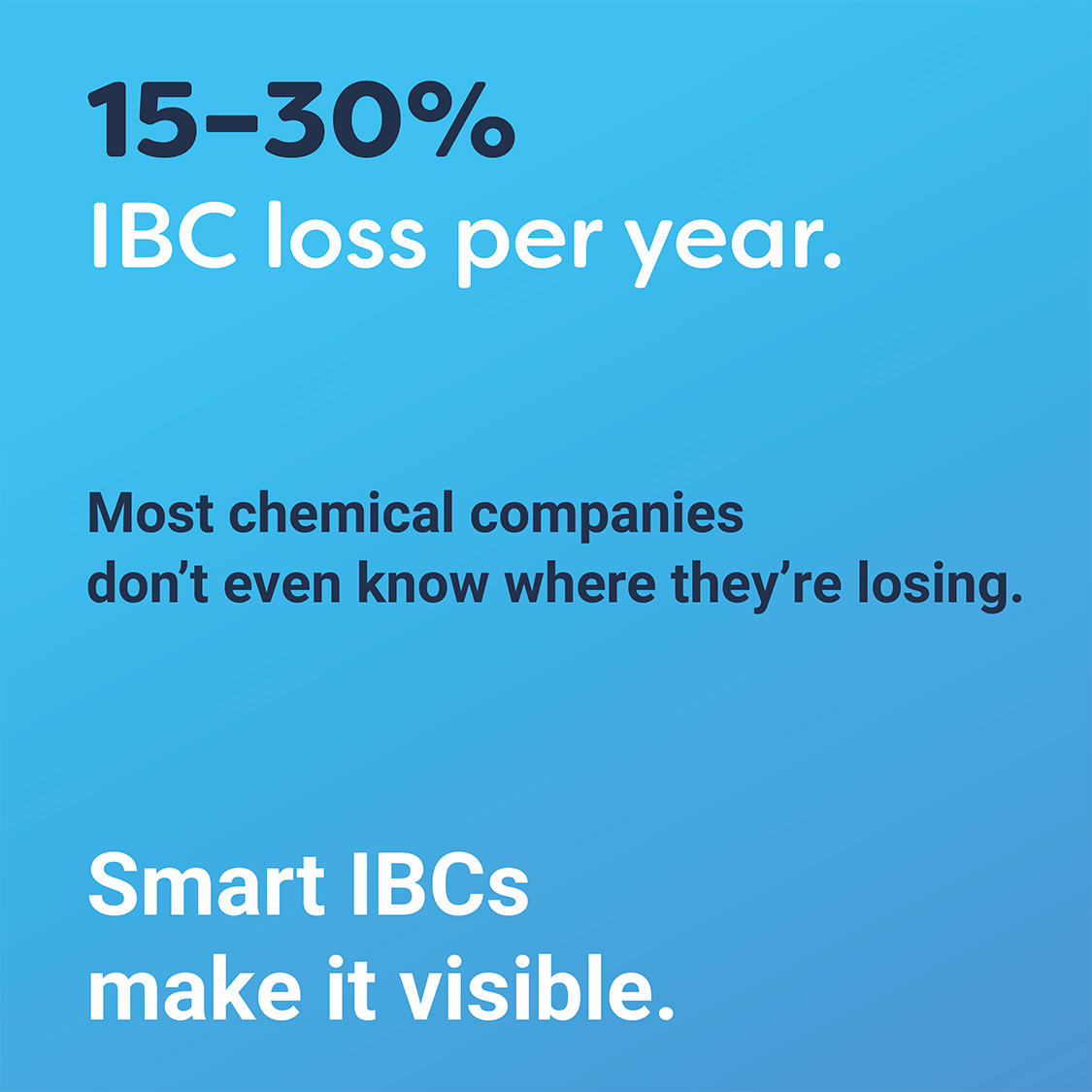
IBC shrinkage is an underestimated cost factor in the chemical industry. Depending on the process, container volume and degree of transparency, companies can lose a significant proportion of their IBCs every year or no longer clearly allocate them. In practice, loss rates of 15 to 30 percent per year often become apparent if containers are not digitally monitored.
The problem is that many chemical companies do not even know exactly where they are losing them.
Is the IBC missing from the customer? Is it empty in the warehouse? Has it not been reported back? Is it on its way but not documented? Or has it already been replaced, even though it is still in circulation?
This is precisely the core of the problem. IBC loss does not only occur because a container physically disappears. It mainly occurs where there is a lack of transparency. Smart IBCs make these losses visible and help companies to manage their containers in a targeted manner instead of chasing after them.
What does IBC shrinkage actually mean?
IBC shrinkage describes the loss or no longer clear allocation of intermediate bulk containers. An IBC does not necessarily have to be stolen or damaged. It is often enough that it is not clear where it is, what condition it is in or when it will be returned.
Typical situations are
- An IBC is at the customer's premises for longer than planned.
- An empty container is not reported for collection.
- A container has been entered incorrectly manually.
- Several locations are working with different lists.
- The container is on its way but not visible in the system.
- Replacements are procured even though there are actually enough IBCs in circulation.
This gradually creates a growing blind spot in the container pool. Individual ambiguities add up to real losses, higher inventories and unnecessary process costs.
Why 15 to 30 percent IBC loss can be so expensive
An annual loss rate of 15 to 30 percent sounds abstract at first. In practice, however, it means that a relevant proportion of the container pool is not available where it is needed.
This causes direct and indirect costs.
Direct costs arise from the purchase or replacement of IBCs. But the hidden costs are often even greater. Employees have to investigate, contact customers, write e-mails, check data and re-coordinate transportation. At the same time, there is a lack of containers for new deliveries.
Typical costs arise from:
- replacement procurement of new IBCs
- manual tracking
- Delayed returns
- additional coordination with customers and logistics partners
- higher safety stocks
- longer downtimes
- unnecessary transportation
- working time tied up in logistics, purchasing, scheduling and customer service
The larger the container pool, the greater the impact of shrinkage on margins, delivery capability and operational efficiency.
Most companies do not know where they are losing
The sentence "Most chemical companies don't even know where they are losing out" sums up the problem in a nutshell.
It is often not the will to optimize that is lacking, but the database. Without digital visibility, companies only see sections of their IBC cycle. They may know when a container has left the plant. But they do not know reliably where it is afterwards, whether it is still full, whether it is empty or when it will be available again.
This leads to typical questions in everyday life:
- Where is the IBC at the moment?
- Is the container full, empty or in use?
- When can it be retrieved?
- How long has it been at the customer's premises?
- Has it been handled correctly?
- Does a new IBC really need to be procured?
If these questions can only be answered manually, delays, uncertainty and unnecessary costs arise.
The most common causes of IBC losses
IBC shrinkage is rarely caused by a single error. It is usually the result of many small gaps in the process.
It becomes particularly critical when IBCs circulate between the plant, customer, warehouse, shipping, cleaning and reprocessing. The more stations are involved, the more difficult it becomes to control them without digital support.
Common causes are
- no real-time overview of location and status
- Manual inventory management with Excel, email or paper lists
- Unclear retrieval processes
- Lack of fill level information
- long downtimes at the customer's premises
- incomplete data in internal systems
- multiple locations and partners involved
- lack of transparency regarding temperature, movement or shock events
The result: IBCs are searched for instead of actively controlled.
Why manual processes are no longer sufficient
Many chemical companies still manage their IBCs using manual lists, emails or telephone coordination. This can work for small inventories. However, with larger container volumes and multiple interfaces, this approach quickly reaches its limits.
Manual processes do not provide real-time data. They only ever show a snapshot. As soon as information is delayed, duplicated or not maintained at all, the actual stock is no longer reliable.
This leads to typical problems:
- Recalls are made too late.
- Inventories are set too high.
- Containers are replaced unnecessarily.
- Transports are not optimally planned.
- Teams spend too much time coordinating.
- Decisions are based on assumptions instead of data.
If you want to reduce IBC shrinkage, you need to create transparency. Not at the end of the month, but on an ongoing basis in daily operations.
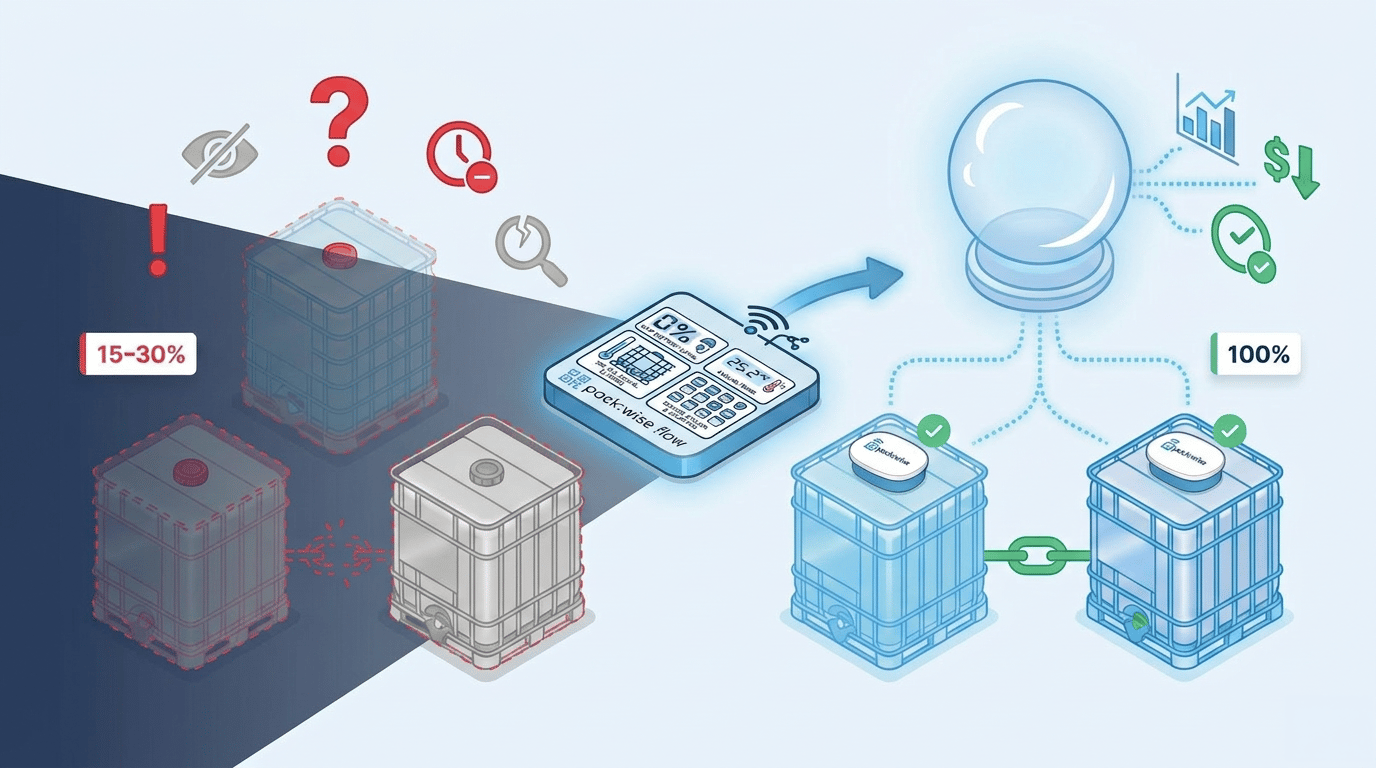
Smart IBCs make losses visible
Smart IBCs combine the physical container with digital data. To do this, the container is equipped with sensors and mapped via a platform.
This allows important information to be recorded automatically, for example
- Location
- fill level
- movement
- shock
- temperature
This data shows where an IBC is located, how it is being used and when action is required. As a result, companies not only recognize that losses occur, but also where and why they occur.
This is precisely the crucial difference: without digital data, IBC shrinkage often remains invisible. With smart IBCs, it becomes measurable, controllable and reducible.
Where the economic benefits arise
Digital IBC monitoring creates tangible benefits in three areas in particular: Logistics, inventory management and quality management.
1. logistics: better retrieval and less downtime
With digitally visible IBCs, returns can be planned much better. Companies can see which containers are at the customer's premises, which are empty and which can be put back into circulation.
This reduces downtime, avoids losses and improves the utilization of the existing container pool. Transports can also be planned more efficiently because deliveries and returns are better coordinated.
The result: less searching, fewer empty runs and more available containers.
2. inventory management: fewer safety stocks
Without clear data, companies often hold more IBCs than they actually need. This provides security in the short term, but causes costs in the long term.
Digital inventory monitoring shows how many containers are actually available, filled, empty or on the way. This allows purchasing and scheduling to plan more accurately.
Instead of procuring additional containers on suspicion, decisions are made on the basis of real usage data. This reduces capital commitment and improves the utilization of existing stock.
3. quality management: recognizing risks earlier
Product safety is particularly important in the chemical industry. Temperature deviations, strong movements or shock events can affect quality.
Smart IBCs make such events visible. Companies can react more quickly, better understand the causes and reduce quality risks.
This supports complaint management, audits and compliance with internal quality standards. At the same time, safety is increased along the entire supply chain.
More service for customers and partners
Digital IBC control not only improves internal processes. It also creates a better service for customers and partners.
If fill levels are available digitally, subsequent deliveries can be better planned. If empties are visible, returns can be organized more reliably. And when condition data is documented, the entire supply chain becomes more traceable.
This is a clear competitive advantage for chemical companies. Today's customers not only expect high-quality products, but also reliable, transparent and digital processes.
Sustainability through better container utilization
IBC shrinkage is also a sustainability issue. Every lost container must be replaced. Every unnecessary transport causes additional emissions. And every unused IBC ties up resources.
Digital transparency helps to use reusable containers more efficiently. Downtimes can be reduced, transports can be better planned and existing containers can be used for longer.
In this way, companies combine economic benefits with greater resource efficiency and a better CO2 balance.
For whom is digital IBC monitoring worthwhile?
Digital IBC monitoring is particularly worthwhile for companies with high container volumes, multiple locations and complex supply chains.
The approach is particularly relevant for
- Chemical manufacturers
- Chemical distributors
- Retailers with reusable containers
- Companies with temperature-sensitive products
- Companies with high return costs
- Organizations with manual container management
Typical departments that benefit are logistics, supply chain management, purchasing, scheduling, quality management, operations, sales and customer service.
The more interfaces an IBC passes through, the greater the benefit of digital transparency.
Best practice: How companies get off to the right start
Getting started with digital IBC monitoring should be done pragmatically. It is important to start with clear goals and make the benefits measurable.
Five steps have proven successful:
- Analyze the container pool
How many IBCs are in use? Where are they located? Which processes cause the most effort today?
- Make loss points visible
Where do shrinkage, long downtimes or manual effort occur? This is where the greatest leverage usually lies.
- Start a pilot project
A limited container pool is ideal for measuring initial results and gaining experience.
- Integrate data into processes
The greatest benefit is achieved when location, fill level and condition data is used directly in logistics, scheduling and customer service.
- Scale step by step
After a successful start, the solution can be expanded to other locations, customers or container groups.
Conclusion: If you make IBC losses visible, you can reduce them
IBC shrinkage is a real cost and efficiency factor in the chemical industry. What is particularly critical is that many companies do not know exactly where their losses occur.
This is exactly where smart IBCs come in. They make the location, fill level and condition visible, reduce manual effort and help to make logistics, inventory management and quality assurance more efficient.
For chemical companies, this means fewer losses, better processes, more satisfied customers and a stronger supply chain.
Make visible where your IBCs are lost. Arrange a no-obligation demo now and find out how Packwise can help you reduce IBC shrinkage and make potential savings measurable.