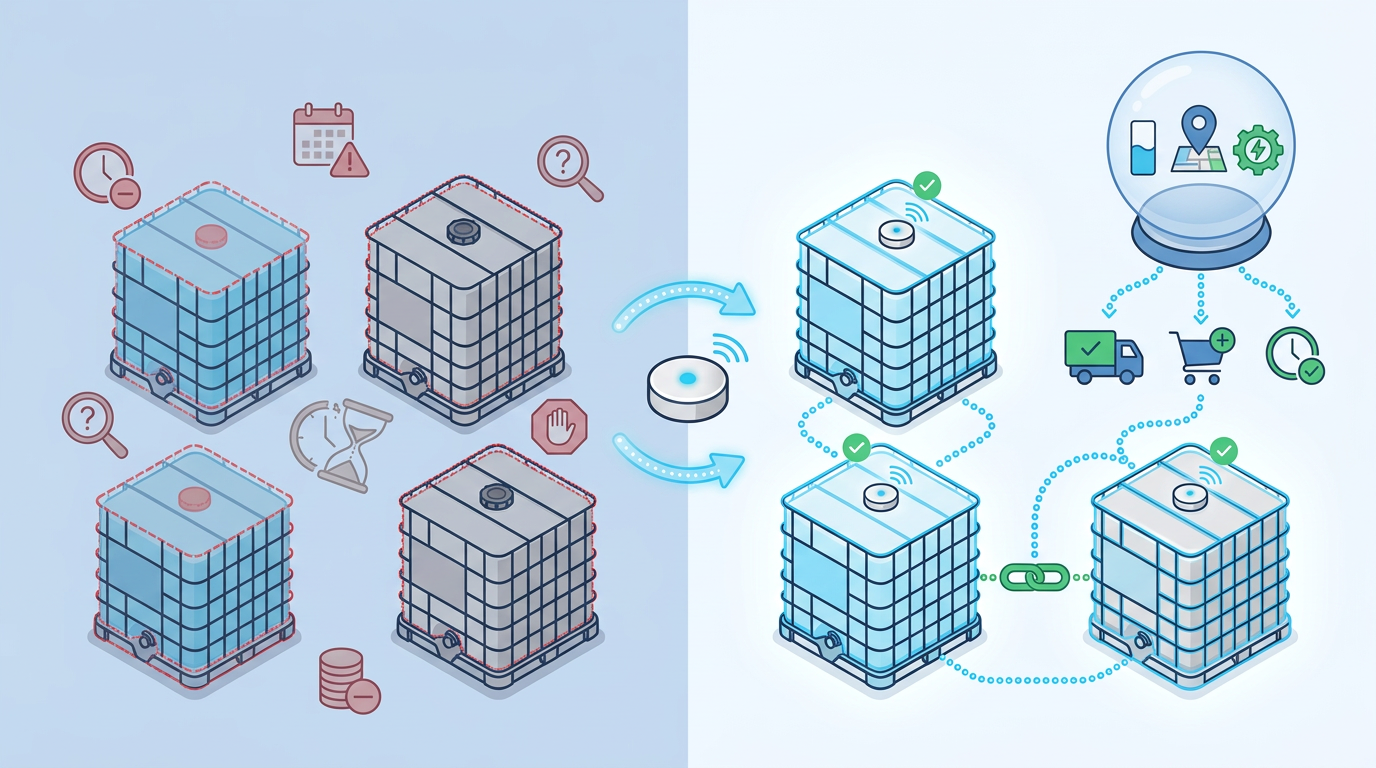
An IBC located at a customer’s site, in an off-site warehouse, at a logistics service provider, or at a depot is rarely just “a container.” It is tied-up capital. It is part of your supply capability. It determines whether a raw material returns on time, whether a customer places a repeat order, whether production planning is reliable, and whether a reusable fleet is truly operating economically.
That is exactly why IBC demurrage costs are so dangerous: they often arise not from a major mistake, but from many small delays. An IBC container is emptied later than expected. An empty container isn’t reported. A return order is left unprocessed. A container is listed as available in the system but is actually still at the customer’s site. No one knows for sure whether it’s full, empty, in transit, damaged, or already ready for pickup.
The result: downtime increases, turnaround times get longer, returns are delayed, new IBCs are purchased or rented as a precaution—and avoidable costs creep into the supply chain.
The good news: A large portion of these costs does not arise because IBC logistics has to be complicated by nature. It arises because companies still manage their reusable containers with too little real-time data. This is exactly where IBC tracking, fill level monitoring, location data, and automated workflows come into play.
What does demurrage actually mean?
The term “demurrage” originally comes from international container logistics. There, it describes fees incurred when a container remains in the terminal too long after an agreed-upon free time has expired. “Detention,” on the other hand, describes the time during which a container is used outside the terminal and is not returned empty on time. In ocean freight, demurrage is typically defined as the time filled containers spend in the terminal, while detention covers the time outside the terminal until the empty container is returned. Both terms refer to delay charges that apply after the agreed-upon free time (container free time) has expired.
In the German logistics context, these costs are often associated with terms such as terminal demurrage, container usage fee, free time, storage charges, demurrage costs, or detention. Demurrage is usually understood as terminal demurrage after the free time has expired, while detention refers to usage fees for containers not returned on time outside the terminal.
For IBC containers, the term demurrage is not always used in the same way as in ocean freight. In practice, “IBC demurrage costs” usually refers to costs incurred when intermediate bulk containers remain in circulation, at the customer’s site, or at a location longer than planned. The underlying principle is therefore the same: a container is not available on time, even though it is needed for the next cycle, cleaning, reconditioning, refilling, or return.
What are IBC demurrage costs?
IBC demurrage costs are direct or indirect costs that arise when IBCs remain in one location for too long, are returned late, or are not reliably identified in the system as available, empty, full, or in transit.
These include, for example:
- additional rental or usage days for IBCs,
- internal downtime costs for tied-up reusable containers,
- costs for replacement containers or safety stock,
- express shipments due to a lack of available containers,
- administrative effort for inquiries, coordination, and manual inventory checks,
- Delays in cleaning, reconditioning, and refilling,
- Higher capital tied up due to oversized container fleets,
- Loss of transparency regarding fill levels, location, and actual availability.
In many industries, an IBC tank or IBC container is far more than just packaging. It is part of a cycle. IBCs are used for the transport and storage of liquid media, including in the chemical, food, pharmaceutical, and related industries. They offer a safe solution for transporting liquid media, including hazardous goods. When this cycle stalls, costs do not rise linearly but often spike: A missing container can delay a reorder, make a delivery run uneconomical, or trigger an additional purchase.
Why do IBC demurrage costs arise?
In most companies, IBC demurrage costs do not arise because no one is responsible. They arise because the necessary information is available too late or not at all.
Typical causes include:
1. No current location
Without IBC location tracking, the team often only knows where a container was last booked—not where it actually is. Days or weeks can pass between the ERP booking and reality.
2. No transparent fill level
If the IBC fill level isn’t recorded digitally, it remains unclear whether a container is still in use, will soon be empty, or has long been ready for pickup. The customer has to actively report it, sales has to follow up, logistics has to wait—and the container just sits there.
3. Manual communication
Emails, phone calls, Excel lists, and manual updates work for small quantities. With larger fleets, they become a risk: information is outdated, inconsistent, or not visible to everyone involved.
4. Lack of Pickup Triggers
Many companies only initiate pickups once a customer notifies them. If this notification is not received, downtime occurs. This is particularly critical for reusable fleets, as every additional day in the field reduces turnover speed.
5. No Reliable KPIs
Without digital data on downtime, turnaround times, fill levels, locations, and movements, it’s hard to pinpoint exactly where demurrage costs are arising. This results in treating the symptoms—but not the root cause.
6. Safety stock instead of transparency
When it is unclear where containers are located and when they will return, additional IBCs are purchased or rented. This may seem like a safe bet in the short term, but in the long run, it increases fleet costs, storage requirements, and capital tied up.
The simple formula behind IBC demurrage
IBC demurrage can be simplified as follows:
Demurrage risk = Number of tied-up IBCs × additional days in storage × internal cost rate per day + follow-up expenses
Depending on the business model, the internal cost rate may include rental costs, depreciation, capital tied up, cleaning, reconditioning, administration, storage space, transportation, and opportunity costs. It becomes particularly costly when downtime blocks downstream processes: a fleet must be oversized, return transports become unplanned, and production or delivery processes lose predictability.
The goal is therefore not merely to avoid individual fees. The actual goal is to digitally manage the container fleet, reduce turnaround times, and return each IBC to its next productive use as quickly as is economically feasible.
Why Digital IBC Tracking Stops Demurrage Costs
Traditional container tracking answers the question: “Where is my container?”
Modern IBC tracking goes further. It also answers:
- Is the IBC full, partially filled, or empty?
- Is the container moving?
- Is it at the correct location?
- Has a temperature limit been exceeded?
- Is the container ready for pickup?
- Does a reorder or return need to be triggered automatically?
- How long has the container been at this location?
- What are the fleet’s overall turnaround times?
It is this combination of asset tracking, IoT level measurement, temperature monitoring, motion detection, and software workflows that transforms an analog container into a controllable supply chain asset.
Instead of finding out after the fact why a container has been sitting at the customer’s site for too long, the system detects early on when a dwell time is becoming critical. Instead of waiting for manual reports, automatic notifications can be triggered. Instead of procuring additional containers, the existing fleet can be utilized more efficiently.
IoT devices make analog IBCs digitally trackable
Modern IoT solutions are integrated directly into the container. Small, retrofittable sensor units are attached to the IBC and continuously collect data on fill level, temperature, location, and movement. This data can be integrated into existing ERP systems via a cloud-based platform.
This is crucial for IBC demurrage: companies don’t just see that a container exists. They see what condition it’s in and what action should be triggered next.
An example: An IBC is at the customer’s site and the fill level drops below a defined threshold. In a manual process, someone would now have to check with the customer or wait for an order. With a digital system, the threshold can be used as an event: The team receives a notification, a reorder can be prepared, and a later pickup can be scheduled. The platform can trigger notifications when, for example, material is running low, a critical temperature is reached, or a delivery arrives. Follow-up processes such as automatic reorders can thus be initiated.
In this way, digital IBC management becomes not just an inventory overview, but an active control tool against idle time costs.
From Tracking to Automated Container Control
Hardware alone does not stop demurrage costs. What matters is what happens with the data. That is why modern solutions combine sensors with browser-based software for intelligent container management. The platform digitally maps the condition of the containers and helps retrieve, view, and share relevant data—such as fill level, temperature, and location—at any time, and use it to optimize and automate supply chain processes.
The following features are particularly relevant for reducing IBC demurrage costs:
Container Management & Call-to-Action
The platform analyzes containers by location, product, or order number. This makes it possible to identify which containers have been idle for a long time, which are nearly empty, and which need to be retrieved or restocked.
Alerts and Automatic Notifications
Automatic alerts help identify critical downtime, temperature deviations, delivery arrivals, or low stock levels early on. This reduces the risk of an IBC remaining tied up for days or weeks without being noticed.
KPIs for dwell times and turnaround times
Digital data enables the analysis of supply chain KPIs such as turnaround or idle times to maximize the utilization of the container fleet. This makes demurrage measurable—and what is measurable can be optimized.
Data exchange with customers and partners
A key factor is shared data usage. Modern platforms enable selected data to be shared with customers and partners to, for example, initiate automatic container pickup or trigger a reorder when the customer’s inventory is running low. This reduces coordination efforts and prevents returns from failing due to missing information.
ERP integration and interfaces
For companies with larger fleets, it is important that tracking data does not remain isolated. Key parameters such as fill level, location, temperature, vibrations, and movement can be integrated into existing processes in logistics, procurement, production, quality management, and customer service via APIs and webhooks.
IBC Demurrage in Packaging-as-a-Service and Container Rental
This topic is particularly relevant in Packaging-as-a-Service, rental models, and reusable container pools. In these contexts, cost-effectiveness depends directly on how well rental periods, returns, histories, and conditions are documented.
Digital tracking solutions specifically address this area: They create transparency for reconditioning and management, enable seamless sharing of relevant data with customers, offer customer access to selected functions, allow for custom data fields for rental containers, provide access to historical data after the rental period ends, and simplify billing through a clear overview of rental periods.
For IBC demurrage, this means: Companies no longer have to reconstruct retrospectively how long a rental container was in transit or when it was emptied. The relevant history is available digitally. This facilitates fair billing, reduces disputes, and creates a solid foundation for service level agreements.
Digitize existing IBC fleets instead of replacing them
A common objection is: “We already have a large fleet. Do we have to replace all the containers?”
No. Retrofittability is a key advantage of modern IoT solutions.
The available sensor units are designed as plug-and-play solutions that are easily attached to the container and are ready for immediate use. They can be used for plastic IBCs, stainless steel IBCs, tank containers, and stationary tanks. This delivers tangible benefits for existing fleets: Real-time data on location and temperature, alerts for demand-based control, supply chain KPIs such as turnover or downtime, reduced manual effort in tracking, minimization of loss rates, maximization of fleet utilization, and cost reduction for new purchases.
This is crucial for companies with established IBC inventories. An IBC tracking solution doesn’t have to start from scratch. It can begin where the fleet stands today—and digitize precisely those containers where downtime, losses, or return issues have the greatest impact.
Real-world examples: How transparency is transforming IBC logistics
The impact of digital IBC management is particularly evident in closed-loop systems and customer-oriented reusable processes.
An example from the chemical industry: At one manufacturer, the use of digital tracking solutions led to ongoing optimization of costs and processes on both sides of the supply chain. Thanks to precise traceability, containers were always visible and returned promptly; location tracking combined with temperature monitoring also ensured product quality throughout the supply chain.
Another example from chemical distribution: The challenges included a reduced overview of reusable containers in the field, low visibility into customer consumption, high administrative and coordination costs, untapped potential in routing and logistics, as well as rising costs and strained warehouse capacity. After implementing a digital tracking solution, environmental and economic improvements were achieved in logistics, along with reduced labor in production and warehousing, optimized ordering processes, and improved customer loyalty.
These examples show: The benefit lies not only in seeing containers on a map. The benefit lies in deriving better decisions from IBC data—earlier, more automated, and with less manual effort.
How Companies Can Systematically Reduce IBC Demurrage Costs
If you want to stop IBC demurrage costs, you shouldn’t start by buying additional containers, but by creating transparency.
A proven approach looks like this:
1. Make downtime visible
Track how long IBCs spend on average at the customer’s site, in storage, during cleaning, reconditioning, and return transport.
2. Identify critical container groups
Not every IBC incurs the same costs. Prioritize containers with high merchandise value, critical availability, long turnaround times, high loss rates, or complex customer processes.
3. Digitally monitor fill level and location
IBC fill level monitoring and IBC location tracking generate the most important data set: Where is the container located, how full is it, is it moving, and when is it expected to be needed?
4. Define return and reorder triggers
Specify at which fill level, dwell time, or location change an action is automatically triggered.
5. Engage customers and partners
Demurrage often arises at interfaces. When customers, logistics service providers, and internal teams access the same shared data, coordination efforts are significantly reduced.
6. Regularly evaluate KPIs
Measure turnaround time, dwell time, loss rate, container availability, pickup times, fill level trends, and order cycles. This transforms digital tracking into a continuous improvement program.
7. Leverage ERP and process integration
The greatest impact is achieved when IBC data is not kept in isolation but is integrated into procurement, production planning, logistics, quality management, and customer service.
Preventing demurrage means shifting from reactive to autonomous container management
Many companies today only react once a problem becomes apparent: a container is missing, a customer calls, inventory is running low, or a pickup was forgotten. Digital container management turns this principle on its head.
With modern IoT sensors and an integrated platform, the IBC itself becomes a data source. It reports location, fill level, temperature, and movement. The platform converts this into status information, alerts, KPIs, and automated actions. The result is reusable container tracking software that not only documents demurrage but also prevents it proactively.
Of course, digital tracking does not replace clear contracts, clear process accountability, or reliable logistics planning. But it provides the foundation for these processes to function in the first place: real-time data instead of assumptions, events instead of inquiries, automatic triggers instead of Excel lists.
FAQ: IBC demurrage costs explained briefly
What are IBC demurrage costs?
IBC demurrage costs are costs incurred when IBC containers are tied up longer than planned, returned late, or are not available on time due to a lack of transparency. These include rental and demurrage costs, replacement containers, additional transport, administrative expenses, and capital tied up.
What is the difference between demurrage, detention, and downtime?
In ocean freight, demurrage usually refers to fees for containers that remain in the terminal after the free time has expired. Detention applies to containers that are not returned on time outside the terminal. With IBCs, the terms downtime costs, container usage fees, or IBC demurrage are often used more generally.
How does IBC tracking help prevent demurrage?
IBC tracking shows where a container is located, whether it is empty or full, whether it is moving, and whether defined events occur. This allows for automatic triggering of returns, reorders, and escalations before unnecessary downtime occurs.
Why is level measurement more important than pure GPS tracking?
GPS shows the location. The fill level indicates whether the IBC is still in use or will soon be ready for pickup. Only the combination of location, fill level, temperature, and movement makes a container fleet operationally controllable.
Can existing IBC containers be retrofitted with digital technology?
Yes. The available IoT sensors are designed as plug-and-play solutions and can be used on plastic IBCs, stainless steel IBCs, tank containers, and stationary tanks.
Are such solutions also relevant for chemical and hazardous materials logistics?
Yes. There are certified solutions (e.g., ATEX/IECEx) for tracking containers along the supply chain, including in Ex zones. Digital transparency regarding location, fill level, and condition is particularly valuable in the chemical industry, hazardous materials logistics, and regulated supply chains.
Conclusion: IBC demurrage costs are not a fee problem, but a transparency problem
IBC demurrage costs arise when containers are left standing longer than necessary, returns are initiated too late, and no one reliably knows which IBC is where, how full it is, and when it can be returned to the cycle.
To stop these costs, you need more than just an inventory list. Companies need digital, event-based container management: with real-time data, fill-level monitoring, location tracking, automated alerts, shared data access, and clear KPIs for downtime and turnaround times.
Modern IoT sensors and integrated software platforms make exactly that possible: analog IBCs become smart, connected assets. Manual tracking becomes automated control. Unclear downtime becomes measurable KPIs. Delayed returns become predictable processes.
This way, IBC demurrage costs can not only be explained—but also effectively reduced in day-to-day operations and, in many cases, avoided.