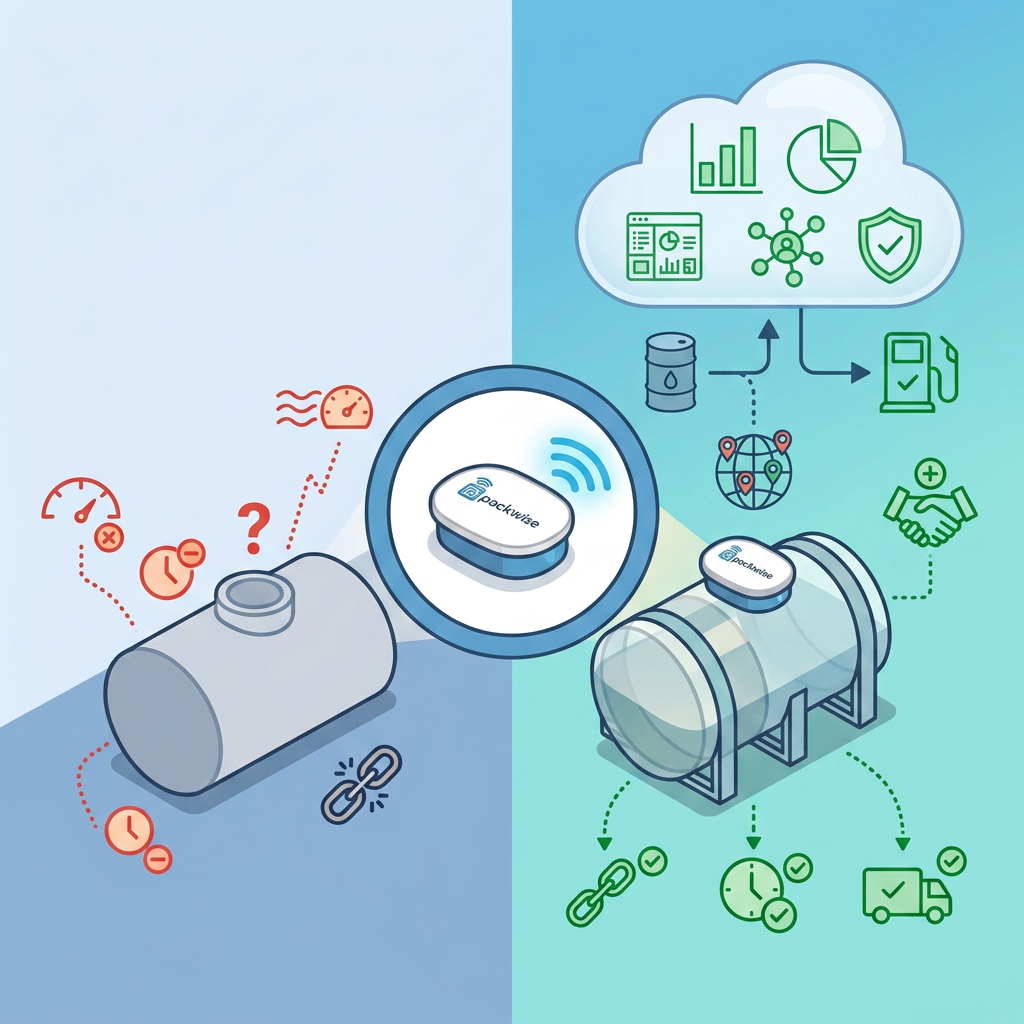
How much product is left in a customer’s tank right now? Which location is approaching a critical inventory level? Which tank needs to be refilled next? Are deliveries being scheduled based on actual demand or estimates? And can this information automatically flow into your ERP, inventory or logistics systems?
For companies managing distributed tanks, bulk liquids and customer inventories across multiple locations, these questions directly affect operational efficiency, delivery planning and customer service.
This is where Remote Tank Level Monitoring becomes a critical part of modern industrial operations.
A modern tank monitoring solution should do far more than display a percentage on a dashboard. It should connect fill level, temperature, location and tank status with IoT hardware, software and business processes.
The goal is not simply to know how full a tank is.
The goal is to turn real-time tank data into better decisions: when to replenish, where to deliver next, how much product is available across the network and which processes can be automated.
In this guide, we look at the most important criteria companies should consider when selecting a remote tank level monitoring solution – from measurement technology and connectivity to ERP integration, automated replenishment and scalability.
We also show how Packwise Flow and the Packwise Smart Cap bring these capabilities together in one Industrial IoT solution.
What Is Remote Tank Level Monitoring?
Remote Tank Level Monitoring uses connected sensors and software to measure and monitor the inventory level of liquids or other materials stored in tanks without requiring someone to manually check each tank on site.
Depending on the application, a modern system can provide information such as:
- fill level
- remaining inventory
- temperature
- location
- movement
- tank status
- historical consumption
- low-level events
- replenishment requirements
This can be particularly valuable for organizations operating stationary tanks, customer tanks, storage tanks, chemical tanks, poly tanks, stainless steel totes, ISO tanks or other liquid storage assets across multiple sites.
Instead of relying on manual readings, phone calls, spreadsheets or estimated consumption, companies gain a digital view of their tank inventory.
Packwise combines the Packwise Smart Cap with the browser-based Packwise Flow platform to monitor both stationary and mobile tanks. The solution collects fill level, temperature, location and movement data and makes this information available for monitoring and process automation.
Why Tank Level Monitoring Is More Than a Sensor
At first glance, remote tank monitoring can appear straightforward:
Install a sensor, measure the level and send the value to a dashboard.
But an industrial tank monitoring system consists of several connected layers:
Tank → sensor → connectivity → cloud platform → analytics → automation → ERP and business systems
A failure at any point in this chain reduces the value of the entire system.
An accurate sensor does not create much value if its data cannot reliably reach the cloud.
A dashboard does not create much value if employees still have to manually check it every hour.
And real-time tank data creates limited operational value if it remains isolated from inventory, logistics and ERP processes.
The right solution therefore needs to be evaluated as a complete Industrial IoT ecosystem, rather than simply as a level sensor.
The Most Important Criteria for Remote Tank Level Monitoring
1. Reliable and Accurate Level Measurement
Everything starts with the measurement itself.
If tank level data is inaccurate or unreliable, every process built on top of that information becomes unreliable as well.
Industrial tank environments can be challenging. Measurement conditions may include:
- vapor
- foam
- changing temperatures
- different liquid properties
- condensation
- difficult tank geometries
- harsh outdoor environments
The measurement technology should therefore match the actual operating environment rather than only performing well under ideal laboratory conditions.
One technology increasingly used for demanding applications is non-contact radar level measurement.
Radar-based measurement can provide advantages because the sensor does not need to be in direct contact with the liquid. Packwise uses radar technology in the Smart Cap for level measurement and positions it for applications where vapor, temperature variations and other difficult operating conditions can affect conventional measurement methods.
The key question is therefore not simply:
“Does the system measure tank level?”
It should be:
“How reliably does it measure the actual product under the conditions in which our tanks operate?”
2. Easy Retrofit Installation
A remote tank monitoring project becomes difficult to scale if every installation requires extensive engineering, wiring or modification of the tank.
This is especially important when hundreds or thousands of tanks are distributed across customer locations, production facilities, terminals or remote sites.
Companies should ask:
- Does the sensor require wiring?
- Is external power required?
- Does the tank need to be modified?
- Is specialized installation personnel required?
- How long does installation take?
- Can existing tanks be retrofitted?
- Can the same solution be used across different tank types?
A retrofit-friendly architecture can dramatically reduce the operational effort required to move from a pilot project to a large-scale deployment.
Packwise designed the Smart Cap as a battery-powered retrofit sensor that can be attached to existing tanks without a complex installation process. The company's U.S. solution is positioned for stationary tanks as well as poly tanks, stainless steel totes, plastic totes and ISO tanks.
3. Reliable Cellular Connectivity Across Distributed Locations
Remote tank monitoring is only truly remote if data can be transmitted from the locations where tanks are actually installed.
Those locations may include:
- customer facilities
- chemical plants
- production sites
- oilfield locations
- warehouses
- distribution centers
- car wash sites
- outdoor tank farms
- remote industrial facilities
Many of these locations cannot depend on a customer's Wi-Fi network.
A professional solution should therefore provide autonomous connectivity that does not require extensive local IT infrastructure.
Important questions include:
- Which cellular technologies are supported?
- Is connectivity available throughout North America?
- Can the device switch between networks?
- What happens when connectivity is temporarily unavailable?
- Can data be buffered and transmitted later?
- Does the customer need to manage SIM cards or carrier contracts?
Packwise supports cellular communication using technologies including NB-IoT, LTE Cat-M1 and GSM, alongside additional connectivity options. According to Packwise, its devices can connect through multiple carriers to increase availability.
The objective should be simple:
The monitoring system should work where the tank is located – not only where the company network is available.
4. Support for Different Tank Types and Tank Geometries
Industrial liquid supply chains rarely consist of one standardized tank.
A company may need to monitor a combination of:
- stationary storage tanks
- customer tanks
- poly tanks
- stainless steel tanks
- totes
- ISO tanks
- mobile tanks
- process tanks
The monitoring platform should therefore be able to translate a sensor measurement into a meaningful inventory value for the specific tank geometry.
This becomes particularly important when tank dimensions vary across a large installed base.
A strong tank level monitoring platform should support calibration data, tank-specific configurations and individual strapping charts where necessary.
Packwise Flow supports standard tank calibration data as well as individual tank strapping charts, allowing level measurements to be adapted to different tank geometries.
5. Real-Time Inventory Visibility Across All Locations
Knowing the level of one tank is useful.
Knowing the status of an entire tank network is much more valuable.
For distributors, manufacturers and bulk liquid suppliers, the real operational benefit comes from understanding inventory across all customer and company locations at once.
A modern platform should answer questions such as:
- Which tanks are below their target level?
- Which customers will require product next?
- How much total inventory is currently in the field?
- Which tanks have enough inventory to postpone a delivery?
- Which locations are consuming faster than expected?
- Where are unusual consumption patterns occurring?
This transforms tank level monitoring from a measurement tool into an inventory visibility platform.
Instead of managing each customer or tank independently, operations teams can prioritize actions across the entire network.
Packwise Flow provides a centralized browser-based environment for viewing and analyzing tank data across stationary and mobile assets.
6. Automated Low-Level Alerts and Replenishment
A dashboard still requires someone to look at it.
That is why one of the most important capabilities of a modern tank monitoring system is automation.
The software should be able to identify predefined conditions and trigger the appropriate action.
For example:
A tank reaches 30 percent.
An alert is generated.
At 20 percent, the location is added to a replenishment workflow.
A delivery can then be prioritized based on actual customer inventory.
More advanced workflows can combine tank level information with consumption patterns, delivery schedules and business data.
This is especially powerful for Vendor Managed Inventory and supplier-managed replenishment.
Instead of asking customers to manually check inventory and place orders, suppliers can proactively manage replenishment based on real demand.
Packwise Flow can use tank data to trigger notifications and automated processes, including replenishment-related workflows.
This is one of the biggest distinctions between basic remote tank monitoring and an integrated Industrial IoT solution:
Monitoring tells you that something happened. Automation determines what happens next.
7. Consumption Analytics and Demand Visibility
A tank level value is a snapshot.
A tank level history tells a story.
Once level data is collected continuously, companies can begin analyzing:
- average consumption
- daily or weekly usage
- consumption trends
- unusual demand spikes
- expected depletion
- customer-specific demand patterns
- seasonal changes
- delivery frequency
This creates opportunities far beyond simple low-level alerts.
Sales teams can better understand customer demand.
Production teams can improve planning.
Logistics teams can prioritize deliveries.
Procurement teams can anticipate inventory requirements.
And suppliers can potentially move from reactive order fulfillment toward proactive replenishment.
The strategic value of remote tank level monitoring therefore increases significantly when historical data is used to understand how inventory is being consumed, rather than simply how much remains at one moment in time.
8. ERP, Inventory and Logistics Integration
Tank data should not become another isolated software silo.
In many organizations, tank information ultimately needs to interact with:
- ERP systems
- inventory management systems
- transportation management systems
- route planning
- customer portals
- business intelligence tools
- CRM platforms
- procurement systems
- ordering workflows
This is why APIs and webhooks should be an important part of any evaluation.
The ideal architecture allows real-time tank information to become another trusted data source inside the company's existing digital ecosystem.
For example:
Tank reaches threshold → Packwise Flow identifies event → ERP receives information → replenishment workflow starts
Packwise Flow provides API and webhook capabilities for integrating sensor information with external business systems.
A modern tank monitoring solution should therefore extend the existing technology stack rather than require companies to replace it.
9. Device Management for Large-Scale Deployments
A pilot involving 20 tank sensors is relatively easy to manage.
A deployment involving 2,000 devices is different.
Companies operating large sensor networks need to know more than the level inside each tank.
They also need visibility into the monitoring hardware itself.
Questions include:
- Is the device communicating?
- When was the last transmission?
- What is the battery status?
- Which device is assigned to which tank?
- Which firmware version is installed?
- Are there communication issues?
- Can device configurations be changed remotely?
Professional IoT device management becomes increasingly important as deployment size increases.
Software and hardware therefore need to scale together.
10. Security Across the Entire IoT Architecture
Connecting industrial tanks to the cloud means creating a new digital data path.
Security needs to cover the complete architecture:
Sensor → communication → cloud → software → API → user
Companies should evaluate:
- encrypted communication
- device authentication
- role-based access
- multi-factor authentication
- secure API access
- firmware security
- remote software updates
- cloud security
- user permissions
This is especially important when tank information is shared with customers, distributors, logistics partners or other third parties.
The platform needs to provide useful collaboration without exposing information to unauthorized users.
11. Certification for U.S. Industrial and Hazardous Locations
For the U.S. market, certifications should be evaluated based on the actual operating environment.
This is particularly important in industries such as:
- chemical manufacturing
- specialty chemicals
- oil and gas
- petrochemicals
- coatings
- solvents
- industrial cleaning products
A device installed in a hazardous location must be suitable and certified for that specific environment.
For North America, Packwise offers both the Smart Cap for ordinary industrial applications and the Smart Cap Ex for hazardous locations. Packwise states that its standard Smart Cap has FCC and Ordinary Location approvals, while the Smart Cap Ex has certification for hazardous-location use in North America.
For U.S. buyers, the important question is therefore not simply whether a sensor is “explosion protected.”
It is:
“Does the device carry the appropriate certification for the location and application where we intend to install it?”
12. Scalability From a Pilot to a Nationwide Tank Network
Many remote tank monitoring projects begin with a small group of tanks.
That is often the right approach.
But the architecture should be selected with the larger rollout in mind.
A system that works well with 25 devices may become difficult to manage with 2,500.
Before choosing a solution, companies should consider whether it supports:
- bulk tank onboarding
- centralized device management
- multiple sites
- multiple customers
- user roles and permissions
- tank grouping
- configurable measurement intervals
- automated alerts
- API integrations
- large data volumes
- historical reporting
This consideration is particularly relevant in the United States, where tank networks can be distributed across very large geographic areas.
Packwise's U.S. offering supports cellular connectivity in North America, and the company reported in 2025 that Smart Caps were already operating in 46 U.S. states.
The right system should therefore allow a company to start small without having to start over when the project succeeds.
Key Criteria at a Glance
| Criterion |
Key Question |
| Level measurement |
Is the level measurement reliable under real operating conditions? |
| Sensor technology |
Is the measurement method appropriate for the liquid and tank environment? |
| Retrofit installation |
Can existing tanks be equipped without complex modification or wiring? |
| Connectivity |
Can tanks communicate independently at distributed locations? |
| Tank compatibility |
Can different tank types, sizes and geometries be supported? |
| Inventory visibility |
Can teams see inventory across all locations in one platform? |
| Automation |
Can low levels automatically trigger alerts or replenishment workflows? |
| Analytics |
Can historical data reveal consumption and demand patterns? |
| Integrations |
Can tank data flow into ERP, logistics and inventory systems? |
| Device management |
Can hundreds or thousands of sensors be managed efficiently? |
| Security |
Is the entire data chain from device to user protected? |
| Certification |
Is the hardware approved for the intended U.S. operating environment? |
| Scalability |
Can the solution grow from a pilot to a nationwide deployment? |
Where Remote Tank Level Monitoring Creates the Most Value
Remote monitoring can create value anywhere industrial liquids are stored and replenished across multiple locations.
Chemical Distribution
Chemical distributors often manage product stored at customer facilities.
Remote tank level monitoring can provide continuous visibility into customer inventory and help suppliers schedule deliveries according to actual consumption rather than estimated demand.
This creates the foundation for more efficient Vendor Managed Inventory models.
Chemical Manufacturing
Chemical producers may operate tanks across production facilities, warehouses and customer sites.
Connected tank data can improve inventory transparency and help operations teams identify shortages before they affect production or customer supply.
For hazardous environments, appropriate hardware certification becomes an additional requirement.
Oil & Gas and Oilfield Chemicals
Remote locations make manual inventory checks expensive and inefficient.
Connected level monitoring can provide visibility into chemical inventories without requiring repeated site visits solely to check tank levels.
Automotive and Car Wash Operations
Car wash networks consume detergents and treatment chemicals across many distributed sites.
Monitoring tank levels remotely can help chemical suppliers understand consumption and schedule replenishment before a location runs out of critical products.
Packwise identifies chemical manufacturing, oil and gas and automotive/car wash applications among the industries using remote tank level monitoring in the North American market.
Industrial Manufacturing
Manufacturing facilities depend on a wide range of liquids, lubricants, additives and process chemicals.
A shortage of a relatively inexpensive material can potentially interrupt a much more valuable production process.
Remote monitoring can therefore provide visibility into critical material inventories before they become an operational issue.
Stationary Tank Networks
Companies operating hundreds of stationary tanks across customers, branches or production sites face a fundamentally different challenge from managing one tank at one facility.
They need a centralized view across the entire network.
This is where connected tank monitoring becomes particularly valuable: individual measurements can be combined into one inventory management and replenishment system.
From Tank Monitoring to Automated Replenishment
The biggest opportunity in remote tank monitoring is not the dashboard itself.
It is what companies can do with the data.
Consider a traditional process:
Customer checks tank → customer notices low inventory → customer contacts supplier → order is entered → delivery is scheduled
Every step depends on a human action.
With connected tank monitoring, the process can become:
Sensor detects inventory level → software identifies threshold → supplier receives notification → replenishment is scheduled
And with deeper integration:
Sensor data → monitoring platform → ERP → replenishment workflow → optimized delivery planning
This shift is important because it changes the role of tank level data.
It is no longer simply information.
It becomes a trigger for business processes.
Packwise Flow and Smart Cap: A Practical Example
Packwise combines its Smart Cap sensor with Packwise Flow to create an integrated remote tank monitoring solution.
The Smart Cap collects information including fill level, temperature, location and movement, while Packwise Flow makes this information available through a browser-based software environment. The platform supports both stationary and mobile tanks and can use tank information for monitoring, analytics and automated workflows.
Rather than requiring companies to build their own combination of sensor hardware, connectivity and monitoring software, the hardware and software are designed to operate as one system.
For level measurement, the Smart Cap uses non-contact radar technology.
For distributed deployments, the device supports cellular communication technologies including NB-IoT, LTE Cat-M1 and GSM.
Packwise Flow can also connect tank data with external systems through APIs and webhooks, allowing sensor information to become part of existing inventory, logistics and ERP processes.
For U.S. industrial applications, Packwise offers hardware for both ordinary and hazardous locations, with corresponding North American certifications.
The result is an architecture that connects the physical tank directly with digital business processes.
Conclusion: Good Tank Level Monitoring Turns Inventory Data Into Action
The most important question when evaluating a remote tank level monitoring solution is not:
“Can it tell me how full my tank is?”
Most monitoring systems can provide some version of that information.
The more important question is:
“What can our organization do with that information?”
A modern Industrial IoT solution should provide reliable level measurement, simple retrofit installation, autonomous connectivity, centralized inventory visibility and scalable device management.
But it should go further.
It should connect level data with alerts, replenishment workflows, analytics, ERP systems and operational decisions.
That is when remote tank monitoring moves from being a measurement tool to becoming part of the company's supply chain infrastructure.
And that is ultimately where the largest business value lies:
knowing how much product is available, where it is needed and when action should be taken – before a tank runs empty.
FAQ: Remote Tank Level Monitoring
What is remote tank level monitoring?
Remote tank level monitoring uses connected sensors to measure the amount of product inside a tank and transmit that information to a remote software platform. This allows companies to monitor inventory without sending employees to manually inspect each tank.
What types of tanks can be remotely monitored?
Depending on the hardware and measurement technology, remote monitoring can be used for stationary tanks, poly tanks, stainless steel tanks, customer tanks, totes, ISO tanks and other industrial liquid storage assets. Packwise supports both stationary and mobile tank applications.
How does remote tank level monitoring work?
A sensor measures the level inside the tank and transmits the measurement through a communication network to a cloud-based software platform. Users can then view current levels, historical data and alerts remotely.
More advanced systems can use this information to trigger replenishment or integrate the data into ERP and logistics workflows.
Can remote tank monitoring work without Wi-Fi?
Yes. Industrial remote tank monitoring systems can use cellular communication instead of depending on local Wi-Fi. Packwise, for example, supports cellular technologies including NB-IoT, LTE Cat-M1 and GSM.
What is the benefit of radar tank level measurement?
Radar provides non-contact level measurement and can perform reliably in demanding industrial environments. Because the sensor does not need to touch the product, it can be well suited to applications where liquid characteristics, vapor or other process conditions complicate measurement.
Can tank level monitoring automate replenishment?
Yes. A monitoring platform can use defined inventory thresholds to generate notifications or initiate replenishment-related workflows.
When connected with ERP or logistics systems, tank data can become part of a broader automated supply process.
Can remote tank monitoring be integrated with an ERP?
Modern IoT platforms can expose tank data through APIs or webhooks so that fill levels and related information can be used in ERP, inventory, logistics or business intelligence systems.
Packwise Flow provides API and webhook capabilities for this purpose.
What should companies consider for tanks in hazardous locations?
The monitoring hardware needs to be approved for the specific environment in which it will operate.
In the United States, buyers should verify the applicable hazardous-location certification rather than relying only on European ATEX terminology. Packwise offers the Smart Cap Ex with hazardous-location certification for North American applications.
How much does a remote tank level monitoring system cost?
The total cost depends on factors such as the number of tanks, sensor hardware, connectivity, software capabilities, data requirements, integrations and the level of support required.
Companies should therefore evaluate Total Cost of Ownership together with the expected operational value, rather than comparing hardware prices alone.
Ready to See Your Tank Levels in Real Time?
Want to see how Packwise Flow and the Packwise Smart Cap could work with your tanks and your specific application?
Our team is always available to provide a free, no-obligation demo.
We will show you how Packwise can help you remotely monitor tank levels, gain visibility across distributed inventory, automate replenishment workflows and connect real-time tank data with your existing business processes.