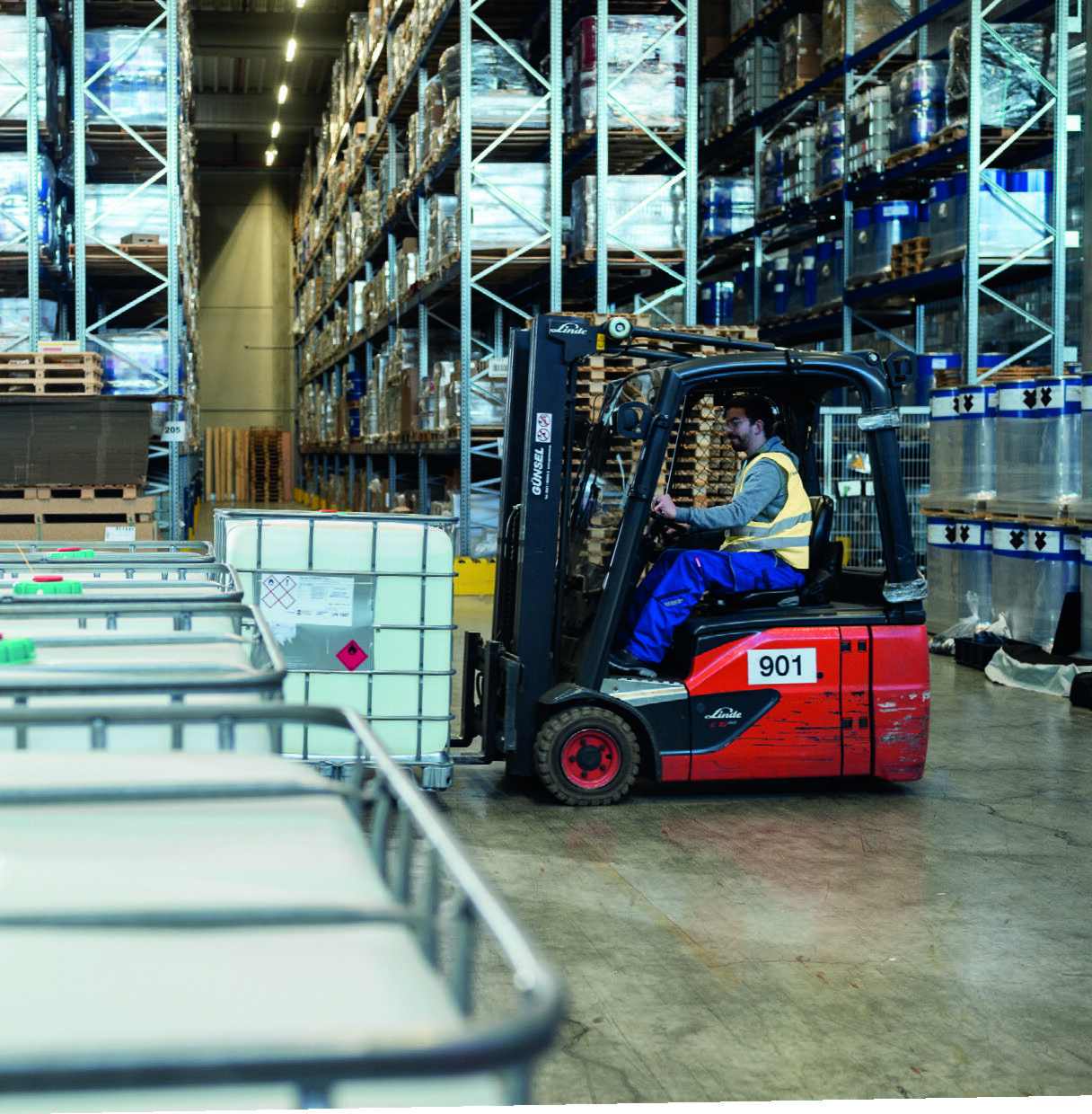
Your IBCs move through the supply chain every day – and nobody knows exactly where they are, how full they are, or whether they arrive intact. What sounds like a minor operational headache is costing mid-sized chemical companies demonstrably six-figure sums annually. Optimizing container management doesn't require new containers. It requires better data.
The Problem: Visibility Stops at the Plant Gate
Picture managing 2,000 IBCs. You know how many you bought. But how many are currently sitting at a customer facility? How many are parked empty in a lot somewhere? How many have already been damaged without a claim ever being filed?
For most logistics and supply chain managers in the chemical industry, this isn't a hypothetical – it's Tuesday. Routes get planned reactively, not proactively. Replenishment orders get triggered because a sales rep noticed an empty container during a site visit – not because a system flagged low inventory ahead of time. Batches expire because temperature swings go undetected. Containers just vanish.
The frustration compounds when you factor in the cost pressures ahead: rising energy prices, tightening environmental regulations around freight emissions, and customers who increasingly expect digital-grade service from their chemical suppliers. Companies that don't build the foundation for real-time inventory visibility now will find those demands impossible to meet with manual processes.
Insight 1: Reactive Route Planning Is Costing You Twice
CVH-Gruppe – a nationwide chemical distributor operating across multiple German locations – ran into a classic data problem: delivery routes were driven by whatever the day threw at them, not by forward planning. The result was redundant trips, underutilized vehicles, and steadily climbing logistics costs.
After deploying smart IBCs, the entire operating model shifted. CVH now manages its customers' orders and call-offs proactively – not because reps are visiting more frequently, but because the platform automatically flags when a product is running low. Every stock movement is fully visible, and every container's contents are traceable from end to end.
The outcome: 20% fewer transport runs and a weekly time savings of 1.5 hours per department. Multiply that across twelve months and multiple teams, and you're looking at dozens of recovered staff hours and meaningful freight cost reductions – before any carbon pricing is factored in.
Improving supply chain efficiency here didn't mean adding headcount or rolling out another ERP module. It meant real-time data that moved the entire planning model from reactive to proactive.
Insight 2: Manual Readings Aren't Just Inefficient – They're Pointless
Häffner GmbH & Co. KG, a European distributor specializing in acids, alkalis, and solvents, ran into a typical scaling problem: more customers, more containers, more manual checking. Reading fill levels was eating staff time without producing anything of value.
After switching to real-time inventory tracking through smart IBCs, that workload didn't shrink – it vanished. 100% of manual fill-level readings were eliminated. No workaround, no transition period, no hybrid approach.
The quality side of the equation is just as compelling: continuous temperature monitoring with automatic deviation alerts reduced waste by 25%. That's not a secondary benefit – it's a standalone ROI driver that almost never shows up in conventional inventory optimization projects, because quality losses from temperature fluctuations rarely get tracked with any precision.
For operations teams looking to digitalize warehouse processes, the right starting point isn't a new warehouse management system. It's the data source itself – the container.
Insight 3: Lead Time Is Not a Procurement Problem
Hesse Lignal, a coatings and adhesives manufacturer, digitalized its entire container lifecycle for the first time through a joint project with BASF – tracking containers from the dispatch of filled units all the way through empty collection and reconditioning.
The result catches most managers off guard: replenishment lead time dropped by 60% – not because of better vendor negotiations, but because administrative friction within the supply chain was eliminated. Simultaneously, workload in scheduling and purchasing fell by 15%.
"Smart IBCs were the ideal solution for optimizing the supply chain. For the first time, Hesse Lignal manages its containers completely digitally – from the dispatch of materials through to the collection of empty containers for reconditioning."
What used to run sequentially with manual handoffs at every step now operates automatically across company boundaries. Frost damage, expired batches, and container losses that used to quietly drain margins are now visible – and actionable.
Insight 4: The ROI Isn't a Projection – It's Already Been Recorded
The strongest case comes from a real customer project at a mid-sized chemical company: an investment of approximately $86,000 generated savings of more than $335,000 over two years.
Those savings break down across five levers: reduced IBC purchases ($56,700), quality management ($121,500), logistics ($48,600), inventory optimization ($81,000), and additional line items ($27,000). That puts the ROI at just under 290% within 24 months.
Here's what makes the numbers genuinely surprising: the single largest lever isn't logistics – it's quality management. That catches decision-makers off guard when they've been thinking about IBC tracking primarily as a location tool. For companies looking to cut production waste and drive down quality costs at the source, this is one of the highest-impact levers available – and one that almost never appears in traditional capital investment analyses.
What Actually Changes on the Operations Floor
The numbers map directly to day-to-day operational shifts. Planners get automated replenishment recommendations instead of waiting on field updates. The ordering process improves by up to 40%, replenishment lead times by up to 60%. Quality assurance shifts from reactive to preventive – temperature deviations get flagged before product becomes unusable. Inventory levels drop by up to 40%, because the safety-stock buffers built around planning uncertainty are no longer necessary.
This isn't an Industry 4.0 talking point. These are changes that plant managers, logistics directors, and supply chain leads will either have to account for in the next quarterly review – or walk in ready to present.
Bottom Line: Every Container Fleet Has Untapped Value
IBCs in chemical distribution get treated like a commodity far too often: buy, fill, ship, hope. Real-world data shows that there can be more than $335,000 sitting inside that "hope" over two years – for a mid-sized operation with a manageable fleet.
Smart IBCs are no longer an emerging technology – they're proven and running at chemical companies today, with documented results.
Want to know what the savings potential looks like for your specific operation? We're happy to work through the numbers with you – no fluff, no pressure, just a straightforward conversation about what's realistic for your fleet size and setup. Reach out to schedule a free, no-obligation call with our team.
📩 sales@packwise.de | 📞 +49 (0) 351 896 750 90 | 🌐 www.packwise.de
Packwise Inc, based in Houston, Texas, builds digital solutions for container and inventory optimization in the chemical industry.