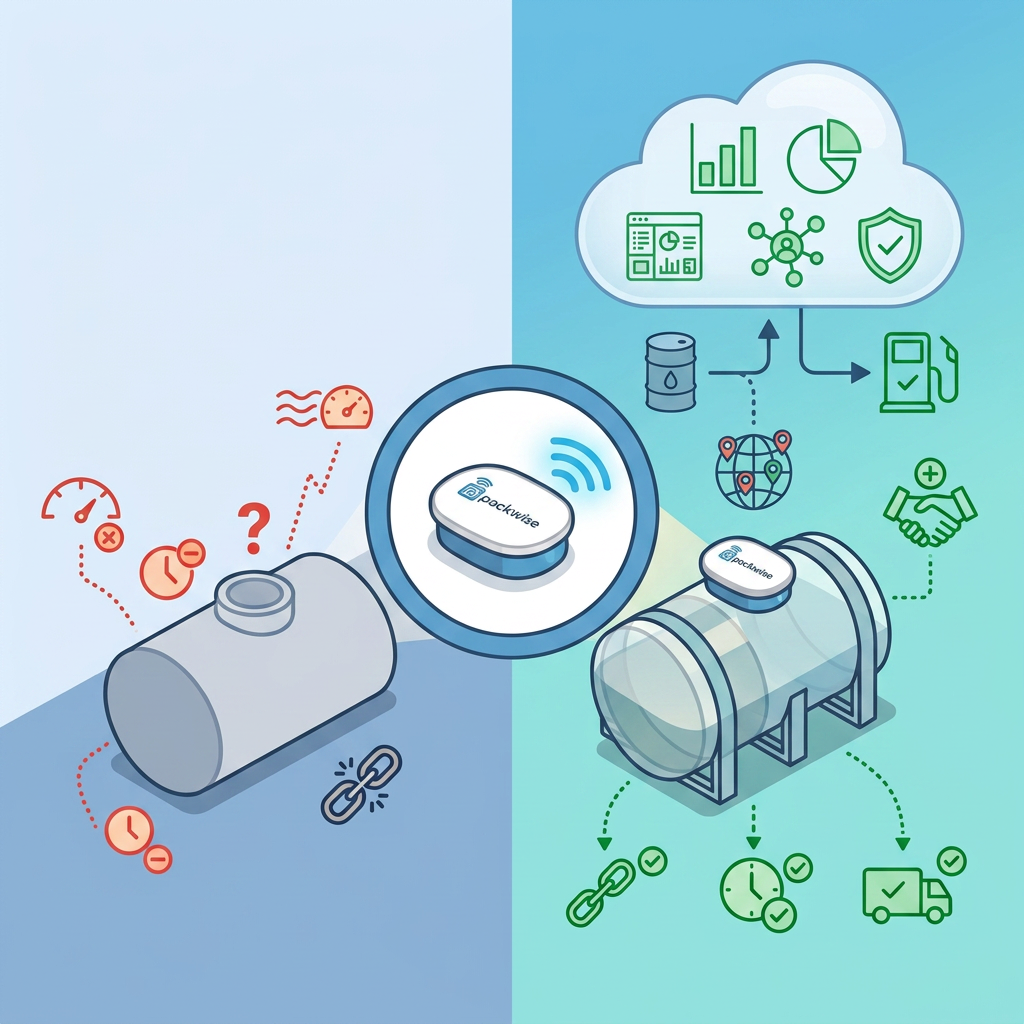
Where is a specific IBC right now? What is the current fill level at the customer's site? Which container has been sitting unused at a location for weeks? Which tank container is nearly empty and should be refilled or collected? And which of this information should automatically be transferred to the ERP system? Companies managing hundreds or thousands of returnable containers, IBCs or tanks quickly realize that professional container management is about much more than displaying a dot on a map.
Modern container management software needs to connect location, fill level, temperature and other condition data with IoT hardware and business processes within one system. Only then can a conventional container become a digitally manageable asset. Companies can not only see where their containers are, but also understand how much material remains, when replenishment will be required and which processes should be triggered automatically. In this cornerstone guide, we explain the key criteria to consider when selecting a solution – from hardware integration and fill level monitoring to system architecture – and show how Packwise Flow and the Packwise Smart Cap address these requirements in practice.
What Is Container Management Software?
Container management software – also referred to as asset or returnable packaging management software – digitally represents physical containers and helps companies monitor and manage their location, condition, inventory, movement and utilization.
Relevant assets include:
- IBCs
- stainless steel IBCs
- returnable containers
- tanks and tank containers
- drums
- rental containers
- pooled packaging assets
It is important to distinguish this use of the term from IT-related “container management,” which usually refers to managing software containers with technologies such as Docker or Kubernetes.
Companies looking to digitalize physical industrial containers should therefore also search for terms such as IBC Tracking Software, Container Tracking Software, IoT Container Tracking or Returnable Asset Tracking Software.
Container management becomes particularly powerful when software is connected to IoT sensors. Instead of relying on manual entries, scans or spreadsheets, the digital asset inventory is based on automatically captured data from the physical supply chain.
Location, fill level, temperature and movement are measured directly at the container rather than entered manually at a desk.
Why Hardware and Software Need to Be Considered Together
One of the most important questions when evaluating Industrial IoT software is:
How does reliable data from the physical container get into the software?
An attractive dashboard delivers limited value if the underlying information is incomplete, outdated or only available through substantial manual effort.
In an IoT environment, the actual solution consists of several interconnected layers:
Physical container → sensors → connectivity → platform → analytics → automation → ERP and other enterprise systems
The quality of container management software therefore needs to be assessed across this entire chain – not just by looking at the user interface.
The Most Important Criteria for Container Management Software
1. Automatic, Near-Real-Time Data Collection
Container management software is only as reliable as the data it receives.
Purely manual systems only reflect events that users have actually recorded. IoT-based systems, on the other hand, can automatically provide status information such as location, fill level, temperature and movement.
The decisive question is therefore not simply:
“Can the software track containers?”
Instead, companies should ask:
“Which information do we receive automatically, and is the data quality sufficient to make reliable business decisions?”
Packwise Flow uses real-time data continuously collected by the Smart Cap and displays it in the context of the relevant container.
2. Easy Hardware Integration and Retrofit Capability
In industrial environments, hardware integration often determines whether an IoT project can scale successfully.
A good solution should avoid requiring existing containers to be extensively modified or wired.
Important questions include:
- How quickly can an existing asset be retrofitted?
- Does the hardware work with plastic IBCs, stainless steel IBCs, tank containers and stationary tanks?
- Is the device suitable for temperature fluctuations, humidity, dust and mechanical stress?
- Can it be used in potentially explosive environments?
- How much maintenance does the hardware require?
The Packwise Smart Cap can be attached to existing IBCs using an adhesive solution without tools or specialized personnel and is ready for use within seconds. It can also be removed without leaving residue and transferred to another container.
For large container fleets, this makes a significant difference. Hardware that requires a complex installation process for every individual asset creates a very different rollout project across 5,000 containers compared with a retrofit solution requiring minimal intervention in existing operations.
3. Reliable Connectivity – Even Outside Your Own Facilities
Containers move.
Today they may be at your own plant, tomorrow on a truck and the next day in a customer's warehouse.
The combined software and hardware architecture must therefore remain reliable beyond the boundaries of a company's own IT infrastructure.
Companies should evaluate questions such as:
- How is data transmitted outside the corporate Wi-Fi network?
- What happens if connectivity is temporarily unavailable?
- Can sensor readings be stored until a connection becomes available?
- How is international and cross-border tracking supported?
The requirement is clear:
Container data must be generated and made available wherever the physical process takes place – not only where corporate Wi-Fi is available.
4. Professional Device Management for Growing Fleets
Ten IoT devices can often be managed manually.
Several thousand cannot.
A scalable platform therefore needs dedicated device management in addition to asset management.
Companies should be able to determine:
Which sensor is associated with which container? Which devices are active? When did they last communicate? Which firmware version is installed?
Packwise Flow provides a centralized and filterable device management environment, including version-specific and SIM-provider filters. This functionality has been specifically expanded to support larger device fleets.
5. A Data Model That Knows More Than a Device ID
From a business perspective, knowing the location of a sensor is not enough.
Companies need to understand which container it belongs to, which product it contains, which customer or order it is associated with and when it needs to be returned.
Only by connecting IoT readings with business context can sensor data become operational information.
Ideally, this creates a digital twin of every container.
Good container management software should therefore support customizable fields, groupings and individual tags rather than forcing companies into a rigid data model.
6. Automation Instead of Permanent Dashboard Monitoring
A good dashboard provides transparency.
A good IoT platform also enables action.
Employees should not have to spend their entire day monitoring a map to discover that a container somewhere has become empty.
The more important question is what happens automatically when:
- a fill level falls below a defined threshold,
- an IBC arrives at a customer's location,
- a temperature threshold is exceeded,
- or a container remains at a particular location for an unusually long period.
Packwise Flow automatically analyzes containers according to parameters such as location, product or order number and can trigger notifications and follow-up processes when predefined events occur – for example, initiating a replenishment process when a customer's inventory is running low.
This highlights the difference between basic container tracking, which describes a status, and true container management, which initiates an action.
7. Open Interfaces for ERP, TMS and BI Systems
Few companies want to introduce another isolated data silo.
Container data may be relevant to ERP and SAP systems, Transportation Management Systems, Warehouse Management Systems, CRM platforms, BI tools, customer portals and dispatch operations.
A professional platform should therefore provide documented and secure interfaces such as APIs and webhooks rather than locking data inside a proprietary user interface.
Packwise Flow is designed to connect with third-party systems. Its API allows fill-level, temperature and location data to be transferred into existing enterprise applications.
This means the software extends an existing IT landscape rather than forcing companies to replace it.
8. Security Across the Entire Chain – Device, Transmission, Cloud and Access
IoT expands a company's potential attack surface.
Security therefore cannot be limited to the web application's user interface. The entire data path – from the device and communication layer to the cloud and user access – must be protected.
Important criteria include:
- encryption during transmission and storage
- individual device identities or cryptographic keys
- role-based access control
- optional two-factor authentication
- independent cybersecurity certification
At Packwise, each device uses individual device-specific cryptographic keys to secure communication. Firmware is stored in encrypted form, cloud environments are protected through firewall services and access to Packwise Flow and its API is secured via TLS connections.
Data access is managed through role-based permissions and can optionally be protected with two-factor authentication. Packwise is also CyberVadis-certified with regard to international IT security compliance standards.
9. Hardware Robustness and Certification for the Operating Environment
Particularly in the chemical, pharmaceutical and food industries, physical hardware safety is just as important as software security.
ATEX/IECEx approval is essential in potentially explosive environments.
The Packwise Smart Cap Ex is approved for ATEX/IECEx Zones 1 and 2 for gas and Zones 21 and 22 for dust. Packwise itself is certified according to DIN EN ISO/IEC 80079-43 and operates a quality management system in accordance with ISO 9001.
This allows the same software platform to be used in both standard and hazardous environments without requiring a change of provider.
10. Scalability from Pilot Project to Global Fleet
Many IoT projects start with between 20 and 100 assets.
The critical architectural question is whether the same process will still work with 10,000 containers.
This is not only a technical question, but also an organizational one.
Structured permissions, bulk editing, filters and groups, standardized hardware configuration and multi-site dashboards are just as important as the ability to securely involve customers and partners.
Returnable containers regularly leave a company's own organization. Scalability therefore also means being able to manage processes that cross organizational boundaries.
11. Controlled Data Sharing with Customers and Partners
A supply chain does not end at the factory gate.
Customers may need access to their current inventory levels. Logistics providers may need information about containers ready for pickup. Reconditioners may need visibility into incoming assets.
The key requirement is a granular permissions model that ensures every external stakeholder can access only the information relevant to them.
Packwise Flow allows users to invite third parties to the platform and selectively share data with them.
This is particularly important for business models such as Vendor Managed Inventory, Packaging-as-a-Service and container rental, where rental status as well as read and write permissions need to be transparently managed.
12. Business Case and Total Cost of Ownership Instead of Feature Lists
The solution with the longest feature list is not automatically the best solution.
Before choosing container management software, companies should define a clear business case.
Potential objectives include:
- reducing container losses
- improving fleet utilization
- shortening turnaround times
- reducing safety stock
- automating replenishment
- creating new data-driven customer services
Total Cost of Ownership should include more than software licenses.
Companies also need to consider IoT hardware, installation, connectivity, integration effort, maintenance and device management.
The relevant question is therefore not simply:
“How much does the solution cost?”
It should be:
“How quickly and with what level of effort can the solution improve an economically relevant process?”
Key Criteria at a Glance
| Criterion |
Key Question |
| IoT data |
Are location, fill level and condition captured automatically? |
| Hardware |
Can existing containers be retrofitted easily? |
| Connectivity |
Does tracking work outside company facilities? |
| Device Management |
Can large sensor fleets be centrally managed? |
| Data model |
Can containers be connected with product, customer and order data? |
| Automation |
Do events automatically trigger actions? |
| Interfaces |
Are APIs available for ERP, TMS and BI systems? |
| Security |
Are device, transmission, cloud and access protected? |
| Hardware certification |
Is the hardware approved for the operating environment, e.g. ATEX? |
| Scalability |
Does the solution work for 100 as well as thousands of assets? |
| Collaboration |
Can data be securely shared with customers and partners? |
| Economics |
Is there a measurable business case and clear TCO? |
Beyond IBCs: Additional Use Cases for Level Monitoring
These criteria do not only apply to mobile IBCs.
They are relevant to almost any container where fill level, condition or location has economic value.
Good container management software should therefore be flexible enough to support additional applications beyond traditional returnable-container logistics:
- Stationary tanks and tank systems: Remote tank level monitoring for customer tanks, plant tanks and distributed tank networks, combining level, temperature, location and condition data rather than providing a simple level reading.
- Silos: Monitoring bulk and dry materials such as granulates, powders and raw materials in plant silos to plan replenishment and avoid production downtime caused by empty silos.
- Cisterns: Digital level monitoring for water or process-liquid cisterns to protect supply availability and manage refill processes.
- Construction-site containers: Tracking and level monitoring for mobile containers at changing and often difficult-to-access construction sites, including location tracking as assets rotate between sites.
- Car washes: Monitoring chemical and cleaning-agent tanks in car wash facilities to identify shortages early and automate replenishment.
The common denominator across all these applications is simple:
Whenever a container – mobile or stationary, liquid or bulk material – has economic relevance, digital level monitoring can create value.
With the Smart Cap and Packwise Flow, Packwise supports both traditional IBC tracking and remote tank level monitoring for stationary tanks, silos and cisterns. The company also serves the car wash segment, where transparent monitoring of chemical and cleaning-agent inventories directly supports operational continuity.
Practical Example: Packwise Flow and Smart Cap
Packwise Flow combined with the Packwise Smart Cap demonstrates how these criteria can work together in practice.
The Smart Cap is attached directly to an IBC without complex installation and can be deployed worldwide immediately. An ATEX/IECEx-certified Ex version is available for hazardous environments.
It transmits highly accurate real-time data on location, fill level, movement and temperature to the browser-based Packwise Flow platform, creating a digital twin of each container.
Packwise Flow consolidates metrics such as the number of containers and material inventory both per location and across multiple locations.
The platform can be integrated into existing systems via an API and allows selected customers and partners to be invited with granular access permissions – for example, to support automated pickups or replenishment processes.
For growing fleets, centralized and filterable device management with version and SIM-provider filters helps maintain visibility across large device inventories.
TLS encryption, device-specific cryptographic keys, role-based permissions and CyberVadis certification support security requirements across the entire data chain.
Conclusion: The Best Container Management Software Connects the Physical and Digital Worlds
When selecting container management software, companies should not focus solely on the user interface.
The key question is:
How completely does the solution connect physical containers with digital business processes?
A future-proof platform makes IoT hardware easy to integrate, delivers reliable real-time data on location, fill level and condition, supports large device fleets, automates processes, connects with existing ERP and IT environments and meets demanding requirements for security, certification and scalability.
Only then does basic container tracking evolve into true container management – and a conventional physical container becomes a manageable smart asset.
FAQ: Frequently Asked Questions About Container Management Software
What is container management software?
Container management software is used to digitally manage and control physical containers and returnable assets. Modern systems combine asset information with IoT data such as location, fill level, temperature and movement, enabling tracking, analytics and process automation.
What are the advantages of IoT-based container management compared with manual management?
IoT systems automatically collect information directly from the asset instead of relying on manual scans or data entries. This makes it possible to continuously monitor locations, fill levels, material inventories, dwell times and critical conditions and automatically initiate follow-up processes.
What should good IBC tracking software provide?
In addition to basic location tracking, important capabilities include condition data, fill level monitoring, alerts, automation, container histories, permissions management, dashboards, device management and interfaces to ERP and logistics systems.
Can container management software be integrated with SAP or an ERP system?
Modern platforms should provide appropriate interfaces. Packwise Flow, for example, can be integrated with ERP, logistics and other enterprise systems via an API, allowing fill-level, location and temperature data to be processed directly in existing applications.
What should companies consider when selecting container management software for the chemical or pharmaceutical industry?
In addition to tracking and process functionality, robust hardware certified for the relevant operating environment and suitable sensor technology are essential. In potentially explosive environments, companies must also ensure that the hardware is approved for the relevant hazardous zone. The Packwise Smart Cap is available as an ATEX/IECEx-certified Ex version for Zones 1, 2, 21 and 22.
How much does container management software cost?
Costs typically depend on fleet size, required IoT hardware, connectivity, software scope, integration requirements and service levels.
For a meaningful comparison, companies should evaluate the Total Cost of Ownership and expected economic value of the use case rather than looking only at the software license fee.
Interested in a Free Demo?
Would you like to see how Packwise Flow and the Packwise Smart Cap can support your specific use case?
We are always happy to provide you with a free and non-binding demo. Together, we will show you how to digitally monitor the fill levels, locations and condition of your containers, IBCs or tanks, automate processes and increase transparency across your supply chain.