

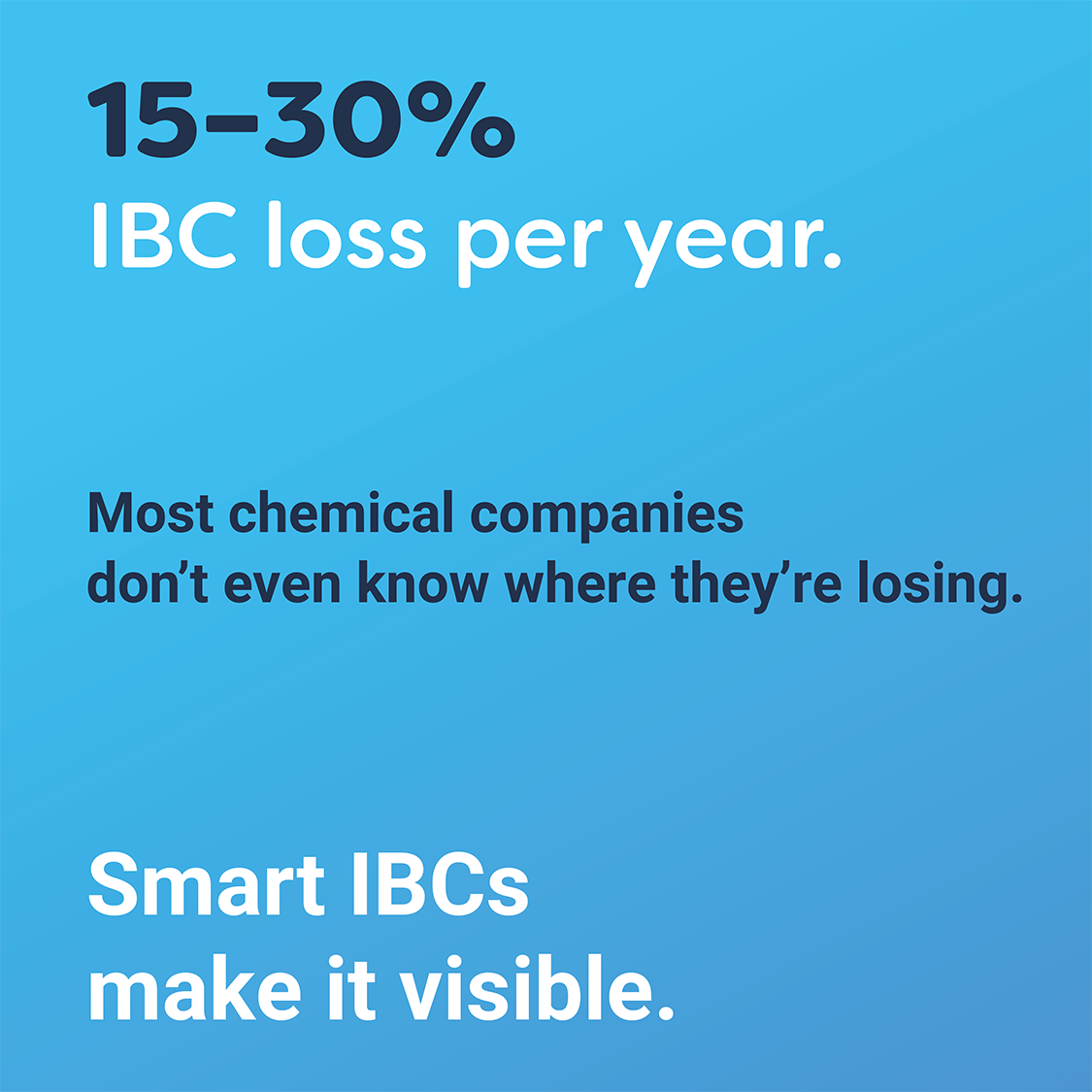
IBC loss is one of the most underestimated cost drivers in the chemical industry. Depending on container volume, supply chain complexity, and process transparency, companies can lose track of a significant share of their IBC fleet every year. In many cases, annual IBC loss rates of 15 to 30 percent become visible once container flows are analyzed more closely.
The real issue is not only that IBCs go missing. The bigger problem is that many chemical companies don’t know where the loss occurs.
Is the IBC still at the customer site? Is it empty and waiting to be picked up? Was it never reported back? Is it in transit but not documented? Or has a replacement already been purchased even though the original container is still somewhere in circulation?
This is where the challenge begins. IBC loss is not always a physical loss. Very often, it is a visibility problem. Smart IBCs make these hidden losses visible and help companies manage their container fleet proactively instead of constantly chasing missing assets.
What Does IBC Loss Actually Mean?
IBC loss refers to the loss, misplacement, or unclear allocation of Intermediate Bulk Containers. An IBC does not have to be stolen or destroyed to become a problem. In many cases, it is enough that the company no longer knows where the container is, what condition it is in, or when it will return.
Typical situations include:
- An IBC remains at the customer site longer than expected.
- An empty container is not reported for pickup.
- A container is recorded incorrectly in a manual system.
- Multiple sites work with different lists or disconnected processes.
- The IBC is in transit but not visible in the system.
- A replacement is purchased even though the original container is still in circulation.
Over time, these small blind spots add up. What starts as isolated uncertainty can quickly become a structural issue that drives costs, increases safety stock, and reduces operational efficiency.
Why 15 to 30 Percent IBC Loss Can Become Expensive
An annual IBC loss rate of 15 to 30 percent may sound abstract. In practice, it means that a meaningful share of the container fleet is not available where and when it is needed.
This creates both direct and indirect costs.
Direct costs arise from purchasing replacement IBCs. But the hidden costs are often even more significant. Employees spend time searching for containers, contacting customers, writing emails, checking data, and reorganizing transportation. At the same time, missing containers are unavailable for new deliveries.
Typical cost drivers include:
- purchasing replacement IBCs
- manual tracking and follow-up
- delayed empty container returns
- additional coordination with customers and logistics partners
- higher safety stock
- longer dwell times
- unnecessary transportation
- administrative workload in logistics, procurement, planning, and customer service
The larger the container pool, the greater the impact on margins, delivery reliability, and overall supply chain performance.
Many Companies Don’t Know Where They’re Losing Value
The statement “Most chemical companies don’t even know where they’re losing value” gets to the heart of the issue.
In many cases, the problem is not a lack of intent. It is a lack of reliable data. Without digital visibility, companies only see parts of their IBC cycle. They may know when a container left the plant, but they don’t reliably know where it is afterward, whether it is still full, whether it is empty, or when it will be available again.
This creates recurring operational questions:
- Where is the IBC right now?
- Is the container full, empty, or still in use?
- When can it be picked up?
- How long has it been at the customer site?
- Was it handled correctly?
- Is it really necessary to purchase another IBC?
If these questions can only be answered manually, delays, uncertainty, and unnecessary costs are inevitable.
The Most Common Causes of IBC Loss
IBC loss rarely has a single cause. More often, it results from many small gaps across the container lifecycle.
The challenge becomes even greater when IBCs move between production sites, customers, warehouses, carriers, cleaning partners, and reconditioning facilities. The more stakeholders are involved, the harder it becomes to manage the process without digital support.
Common causes include:
- no real-time overview of location and status
- manual inventory management using spreadsheets, email, or paper-based lists
- unclear return processes
- missing fill-level information
- long dwell times at customer sites
- incomplete data in internal systems
- multiple sites and external partners involved
- lack of visibility into temperature, movement, or shock events
The result: IBCs are searched for instead of actively managed.
Why Manual Processes Are No Longer Enough
Many chemical companies still manage their IBCs with spreadsheets, emails, or phone calls. This may work for small fleets. But with higher container volumes, multiple sites, and external partners, manual processes quickly reach their limits.
Manual processes do not provide real-time data. They only offer a snapshot. As soon as information is updated too late, entered twice, or not recorded at all, the actual container inventory becomes unreliable.
This leads to common problems:
- returns are initiated too late
- inventory levels are set too high
- containers are replaced unnecessarily
- transportation planning is inefficient
- teams spend too much time on coordination
- decisions are based on assumptions instead of data
Companies that want to reduce IBC loss need to create visibility. Not at the end of the month, but continuously in day-to-day operations.
Smart IBCs Make Losses Visible
Smart IBCs connect the physical container with digital data. The container is equipped with sensor technology and represented in a digital platform.
This enables companies to automatically capture key information such as:
- location
- fill level
- movement
- shock
- temperature
These data points show where an IBC is, how it is being used, and when action is required. Companies can identify not only that losses occur, but also where and why they occur.
That is the crucial difference. Without digital data, IBC loss often remains invisible. With smart IBCs, it becomes measurable, manageable, and reducible.
Where the Business Value Is Created
Digital IBC monitoring creates measurable value in three key areas: logistics, inventory management, and quality management.
1. Logistics: Better Returns and Shorter Dwell Times
With digitally visible IBCs, return processes can be planned much more effectively. Companies can see which containers are at customer sites, which are empty, and which can be brought back into circulation.
This reduces dwell times, prevents losses, and improves utilization of the existing container fleet. Transportation can also be planned more efficiently because deliveries and returns can be coordinated more effectively.
The result: less manual searching, fewer empty runs, and more available containers.
2. Inventory Management: Lower Safety Stock
Without reliable data, companies often keep more IBCs in stock than they actually need. This may create a sense of security in the short term, but it increases costs in the long term.
Digital inventory monitoring shows how many containers are truly available, filled, empty, or in transit. This allows procurement and planning teams to make better decisions.
Instead of purchasing additional containers based on assumptions, companies can plan based on real usage data. This reduces capital tied up in assets and improves fleet utilization.
3. Quality Management: Earlier Risk Detection
Product safety is critical in the chemical industry. Temperature deviations, strong movement, or shock events can affect product quality.
Smart IBCs make these events visible. Companies can respond faster, understand root causes more clearly, and reduce quality risks.
This supports complaint management, audits, and internal quality standards. At the same time, it increases supply chain reliability and product protection.
Better Service for Customers and Partners
Digital IBC management does not only improve internal processes. It also creates better service for customers and partners.
When fill levels are available digitally, replenishment can be planned more accurately. When empty containers are visible, returns can be organized more reliably. And when condition data is documented, the entire supply chain becomes more transparent and traceable.
For chemical companies, this is a clear competitive advantage. Today’s customers expect not only high-quality products, but also reliable, transparent, and digital processes.
Sustainability Through Better Container Utilization
IBC loss is also a sustainability issue. Every lost container has to be replaced. Every unnecessary transportation movement creates additional emissions. And every unused IBC ties up resources.
Digital visibility helps companies use reusable containers more efficiently. Dwell times can be reduced, transportation can be planned more intelligently, and existing containers can be used for longer.
This allows companies to combine cost savings with better resource efficiency and a reduced carbon footprint.
Who Benefits Most from Digital IBC Monitoring?
Digital IBC monitoring is especially valuable for companies with high container volumes, multiple sites, and complex supply chains.
It is particularly relevant for:
- chemical manufacturers
- chemical distributors
- companies using reusable container fleets
- businesses handling temperature-sensitive products
- organizations with high return-management effort
- companies still relying on manual container tracking
The departments that typically benefit most include logistics, supply chain management, procurement, planning, quality management, operations, sales, and customer service.
The more touchpoints an IBC passes through, the greater the value of digital visibility.
Best Practice: How to Get Started
Getting started with digital IBC monitoring should be practical and focused. The key is to begin with clear objectives and make the impact measurable.
Five steps have proven effective:
- Analyze the container fleet
How many IBCs are in use? Where are they located? Which processes currently create the highest workload? - Identify loss points
Where do losses, long dwell times, or manual efforts occur? These areas usually offer the greatest potential. - Start with a pilot project
A defined container pool is ideal for measuring initial results and building internal experience. - Integrate data into daily processes
The greatest value is created when location, fill-level, and condition data are used directly in logistics, planning, and customer service. - Scale step by step
After a successful start, the solution can be expanded to additional sites, customers, or container groups.
Conclusion: What Becomes Visible Can Be Improved
IBC loss is a real cost and efficiency issue in the chemical industry. The most critical part is that many companies do not know exactly where their losses occur.
This is where smart IBCs create value. They make location, fill level, and condition visible, reduce manual workload, and help improve logistics, inventory management, and quality assurance.
For chemical companies, this means fewer losses, better processes, more satisfied customers, and a stronger supply chain.
Make your IBC losses visible. Book a no-obligation demo and discover how Packwise helps you reduce IBC loss, improve container utilization, and unlock measurable savings.